Single Drum vs Double Drum Roller: Which One for Which Layer
Release time: 2026-09-25
A single drum vibratory roller compacts soil, subgrade and aggregate base, and it takes a padfoot drum when the soil is clay. A double drum (tandem) roller compacts asphalt. A pneumatic tyred roller works in the middle of an asphalt rolling sequence, after the tandem’s first passes and before its last ones. Which layer you are building decides the machine, and the lift thickness decides whether its vibration stays on. The rules below come from US federal and state highway documents, each linked where it is used. Your own contract may name a national specification instead, so read its compaction clause first and treat these as the reference point.
Which roller goes on which layer
Read the table from the bottom of the road up.
| Layer or material | Roller | Vibration | Rule behind it |
|---|---|---|---|
| Clay or silty subgrade | Single drum with a padfoot drum | Not set by FHWA | FHWA NHI-05-037, Table 8-4: sheepsfoot or pad foot is the first choice for CH, MH, CL and ML soils |
| Sand, gravel and granular fill | Single drum, smooth drum | On | FHWA NHI-05-037, Table 8-4: vibratory is the first choice for clean sands and gravels |
| Crushed aggregate base and subbase | Single drum, smooth drum | On | FHWA NHI-05-037, section 8.4.6; compacted lifts of 75 to 150 mm under UFGS 32 11 23, paragraph 3.7 |
| Asphalt, breakdown passes | Double drum, vibratory | On, if the lift is thick enough | Caltrans 2025, section 39-2.01C(2)(c), method compaction: at least 7.5 US tons (about 6.8 t) and 2,500 vibrations per minute |
| Asphalt, intermediate passes | Pneumatic tyred | Not applicable | Caltrans 2025, section 39-2.01C(2)(c): oscillating pneumatic, at least 4 ft wide, tyres at 60 psi minimum |
| Asphalt, finish passes | Double drum, static | Off | Caltrans 2025, section 39-2.01C(2)(c): steel-tired 2-axle tandem, at least 7.5 US tons |
| Thin overlay, under about 24 to 30 mm | Double drum, static | Off | Caltrans 2025, section 39-2.01C(15)(b); HMA Paving Handbook 2000, section 18 |
| Bridge deck and the 5 ft next to it | Double drum | Off; oscillation allowed | WSDOT Standard Specifications M 41-10, section 5-04.3(10)A |
Caltrans (the California Department of Transportation) writes its three-roller requirement for “method compaction”, the procedure it uses on asphalt layers thinner than 0.15 ft (about 46 mm), on leveling courses, on replacement surfacing and where density cannot be tested. Thicker Caltrans layers are tested for density instead, and section 39-2.01C(2) sets no roller minimums for them. Caltrans also counts a ton as 2,000 pounds, so its 7.5 ton minimum is about 6.8 metric tonnes.
The single drum roller covers everything below the asphalt and the tandem covers the asphalt itself. The pneumatic roller is the one that crosses over: the FHWA geotechnical manual NHI-05-037 says rubber-tyred rollers “work well for both cohesionless and cohesive soils”, and the asphalt documents use it again in the intermediate position.
Single drum rollers: soil, subgrade and base
A single drum roller has one steel drum at the front and rubber drive tyres at the back. The drum vibrates because an unbalanced mass spins inside it, which is how BOMAG describes its own soil compactors. Vibration pushes sand and gravel particles into a tighter packing, which is why chapter 8 of the FHWA manual calls smooth drum rollers “best suited for granular, relatively non-cohesive soils” and names vibratory smooth drum compactors as the usual tool for aggregate base and subbase (section 8.4.6).
Smooth drum or padfoot
Clay does not respond to vibration the way gravel does. Table 8-4 of the FHWA manual lists sheepsfoot or pad foot rollers as the first choice for high plasticity soils (CH and MH) and for low plasticity clays and silts (CL and ML). The pads push into the lift and knead it from inside.
On many single drum machines the padfoot is a change of drum or drum shell, not a different roller. BOMAG sells a shell kit that makes its soil compactors “particularly suitable for use on cohesive soils”. XCMG’s own online store lists two padfoot options for the XS263J, an “integral convex block drum” and a “split convex block drum” (MachMall, XCMG E-Commerce). The XS163J we list, photographed in our Hefei yard, has a padfoot drum fitted.

A padfoot is also the wrong proof tool on clean sand. The Iowa DOT construction manual says that on A-1, A-2 and A-3 sands with a plasticity index of 0, a sheepsfoot roller “will penetrate the surface more than 3 inches”, so it cannot show that compaction has been reached. The manual allows a rubber-tyred or self-propelled vibratory roller there instead, at one pass per inch of lift.
The J in XS143J or XS263J is not a drum type. XCMG’s store groups its single drum rollers as “economic E series, mechanical J series, hydraulic H series” (MachMall, XCMG E-Commerce), so in that grouping J is the mechanical series. Check the drive type on the unit’s plate, and ask separately which drum is fitted.

How thick a layer one roller can handle
The contract specification usually limits the lift before the roller does. The FHWA manual gives soil lifts as typically 150 to 300 mm (6 to 12 in), and its Table 8-4 notes that high plasticity soils usually need thin lifts. For crushed aggregate base, the US Unified Facilities Guide Specification UFGS 32 11 23 limits “individual compacted lifts to a maximum thickness of 150 mm” and a minimum of 75 mm, and the Caltrans 2025 Standard Specifications say “the compacted thickness of any one layer must not exceed 0.50 foot” (about 150 mm) for aggregate base. Buying a heavier roller does not change those limits; the specification still sets the lift. Our XCMG XS143J to XS263J spec comparison shows how drum load and exciting force change from 14 t to 26 t.
Double drum rollers: the asphalt machine
A tandem roller has a steel drum at each end. Because only steel touches the mat, it leaves no tyre marks, and the handbook’s usual sequence uses a steel wheel roller for both the first and the last passes.
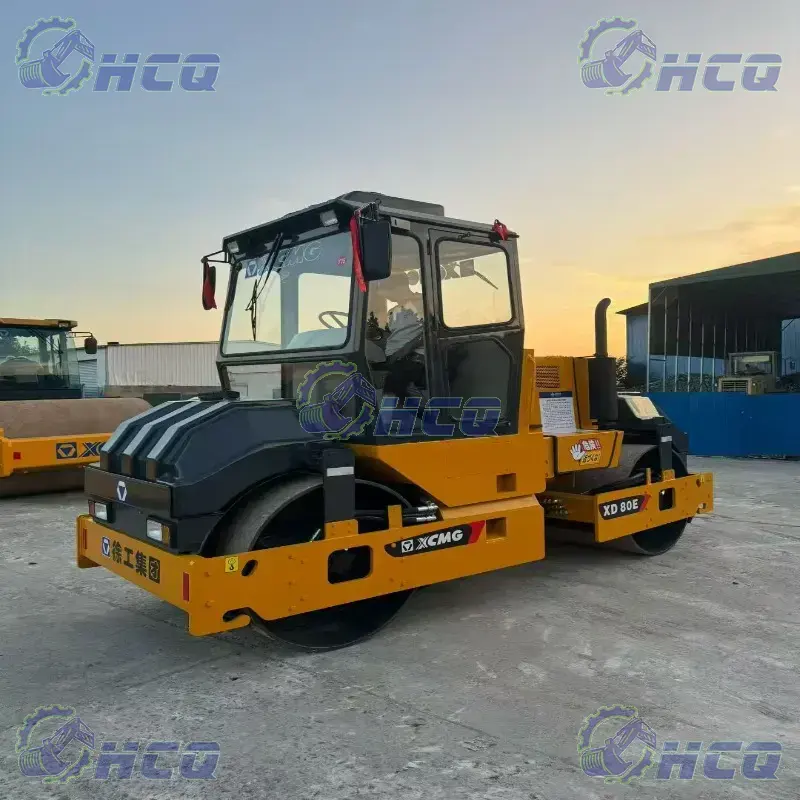
The Hot-Mix Asphalt Paving Handbook 2000, republished by the FAA as an appendix to an airfield paving advisory circular, describes the usual sequence: “Most often, three rollers are used”, a vibratory steel wheel roller for breakdown, a pneumatic tyred roller for intermediate rolling and a static steel wheel roller for finish. Caltrans turns that into minimums for method compaction in section 39-2.01C(2)(c): a breakdown roller of at least 7.5 tons “capable of at least 2,500 vibrations per minute”, and a “steel-tired, 2-axle tandem roller” of at least 7.5 tons for finish.
Tandem size and the Caltrans minimum
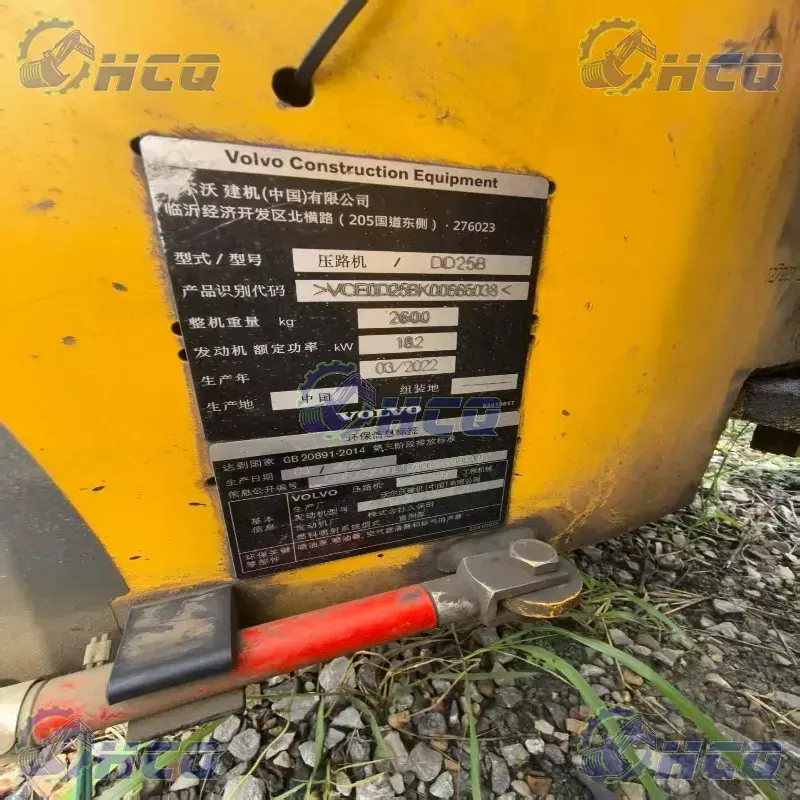
The nameplate on the 2022 Volvo DD25B in our stock gives a machine weight of 2,600 kg, 18.2 kW rated engine power and a production date of March 2022; the maker named is Volvo Construction Equipment (China), at a Linyi address. That is well under the 7.5 US ton (about 6.8 t) Caltrans minimum for a breakdown or finish roller, so a tandem this size would not satisfy that clause on a method compaction job. It is a machine for patching and tight areas that a full-size tandem cannot reach.
Frequency sets the speed
Vibration only compacts evenly if the drum strikes the mat often enough per metre of travel. The 2000 handbook asks for at least 2,000 vibrations per minute and, citing roller manufacturers, puts the ideal impact spacing at “30 to 40 impacts per meter (10 to 12 impacts per foot)”. Caltrans sets a speed limit instead: roller speed in miles per hour must not exceed the vibrations per minute divided by 1,000.
The Caltrans speed limit and the handbook spacing agree. A drum running at 50 Hz makes 3,000 vibrations per minute, so the Caltrans limit is 3 mph, about 4.8 km/h or 80 m per minute. At that speed the drum lands about 37 impacts on every metre, inside the handbook’s 30 to 40 band. Because the Caltrans limit scales with frequency, a roller driven at its limit lands about 37 impacts per metre whatever its frequency. Driving faster opens the spacing and leaves a ripple in the mat.
On amplitude, the handbook says the low amplitude setting “should be maintained unless the compacted thickness of the layer is at least 65 mm (2½ in.)”, and warns that “in most cases” on lifts of 65 mm or less, more force “may cause the aggregate in the mix to fracture and actually reduce rather than increase density”.
Where the pneumatic roller fits
A pneumatic roller runs on a row of rubber tyres. The 2000 handbook says “pneumatic rollers are usually operated in the intermediate roller position, behind a vibratory or static steel wheel” roller. Pavement Interactive, developed by a consortium of US state DOTs, the FHWA and the University of Washington, credits pneumatic rollers with “a tighter, denser surface thus decreasing permeability”. It also warns that the tyre arrangement “may cause deformations in the mat” and that “they should not be used for finish rolling”. The handbook allows pneumatic rollers “occasionally for finish rolling”; Caltrans method compaction requires a steel tandem for the finish.
For tyre pressure, Caltrans asks for an oscillating pneumatic roller at least 4 feet wide, with tyres “inflated to 60 psi minimum and maintained so that the air pressure does not vary more than 5 psi”. The 2000 handbook gives the same 60 psi (400 kPa) floor for intermediate rolling.
The usual complaint with pneumatic rollers is mix sticking to the tyres. The handbook says the tyres “will pick up the mix if the roller moves into the mix when the tires are cold”. It suggests running the roller back and forth for 10 to 15 minutes on cold pavement before paving starts, and another 10 minutes in the intermediate position until the tyres reach mix temperature, with “no water or release agent” on the tyres during that warm-up. Caltrans excludes pneumatic rollers from one rubberized mix: “Do not use a pneumatic tired roller to compact RHMA-G.”
We do not currently list a pneumatic roller for sale.
When the vibration has to go off
Each rule below applies to a vibratory roller that is otherwise the right machine for the layer.
| Condition | What to do | Source |
|---|---|---|
| Asphalt layer thinner than 0.08 ft (about 24 mm) | Turn the vibrator off | Caltrans 2025, section 39-2.01C(15)(b) |
| Asphalt layer thinner than about 30 mm (1¼ in) | Roll in static mode | HMA Paving Handbook 2000, section 18 |
| Lift of 65 mm (2½ in) or less | Keep the low amplitude setting | HMA Paving Handbook 2000, section 18 |
| A vibratory roller doing the finish passes | Turn the vibrator off | Caltrans 2025, section 39-2.01C(15) |
| Bridge decks, and approaches within 5 ft of a bridge | No vibratory mode; oscillatory mode is allowed | WSDOT M 41-10, section 5-04.3(10)A |
| Mix internal temperature below 175 °F (79 °C) | Static mode, unless the engineer approves otherwise | WSDOT M 41-10, section 5-04.3(10)A |
| Aggregate base or subbase laid over biaxial geogrid | “Do not use vibratory devices during compaction” | Caltrans 2025, sections 25-1.03E and 26-1.03E |
| Lime stabilized soil | “Do not use vibratory rollers” | Caltrans 2025, section 24-2.03E |
The two asphalt documents do not agree on the thin-lift cut-off. Caltrans says 0.08 ft, about 24 mm; the 2000 handbook puts it at approximately 30 mm. Working to 30 mm keeps you inside both. The handbook also gives 80 °C (175 °F) as the temperature below which “little density gain was achieved”, so plan the vibratory passes above it.
If you can only buy one roller
- If you only build earthworks, subgrade and base, buy a single drum vibratory roller. If your ground is clay, buy it with a padfoot drum or budget for one, because the FHWA table does not list a smooth drum vibratory roller even as a second choice for high plasticity clay.
- If you only do small asphalt jobs such as patching and car parks, buy a vibratory tandem. The Asphalt Institute notes that “on very small jobs, one roller may be adequate”. Run the vibration for the breakdown passes and turn it off for the finish passes. A highway contract may not accept a single roller: Caltrans method compaction needs a separate breakdown, intermediate and finish roller.
- If you build roads from the subgrade up, you need at least two machines. The Asphalt Institute adds that “on most average projects, two rollers are used”, a vibratory roller for breakdown and a heavy static steel roller for finish. Use a single drum on the base, a tandem on the asphalt, and add a pneumatic roller when the specification asks for one.
A used roller brings its own checks on top of the type choice, starting with drum wear and whether the vibration works at every setting. Our checklist covers those: what to look for when buying a used road roller.
Rollers we list
Single drum machines we list include the XCMG XS123J, XS143J, XS163J, XS223J and XS263J, and a HAMM 320. Double drum machines include an XCMG XD80E, a Dynapac CC622, a BOMAG BW120AD-4 and a 2022 Volvo DD25B. The full list is on our used road roller page. If you send the layer type and the lift thickness in your specification, we will reply with the machines that fit and photos of their drums.
Drafted with AI assistance. Quotations and figures were checked against the linked documents before publication, and HCQ’s export sales team approved the article on 24 September 2026. The roller photographs are of machines in our stock; the layer diagram is an illustration, not a design drawing.