
Used Skid Steer Loader Buying Guide: What the Spec Numbers Mean
Release time: 2026-09-16
Published 16 September 2026 · Reviewed by the HCQ Machinery sales engineering team, Hefei, China
Bobcat’s own T250 specification sheet publishes two operating capacities for the same machine on the same page: 2,500 lb and 3,679 lb. Both are correct. They are one measured tipping load, 7,358 lb, rated under two different factors.
That is the problem with used skid steer listings in a line. The capacity figure is derived, not measured, and the seller chooses which derivation to publish.
The short answer. Rated operating capacity is a capped fraction of the machine’s measured tipping load: no more than 50% for a wheeled loader, no more than 35% for a crawler-rated one. Four things then move the published number without anyone lying, namely the counterweight option, the configuration the unit was rated in, the engine generation, and whether the figure is capacity or tipping load in the first place. Before comparing two quotes, make both sellers say which. Lift path is a fifth variable and is not published at all on several manufacturer sheets, so it has to be confirmed on the unit.
One thing worth saying at the top, because every guide currently ranking for this subject ends the same way: they all tell you to test the machine under load. If the machine is in another country and you are paying against photographs, that instruction is unusable, and the paperwork has to carry the weight the test drive would have carried.
Rated operating capacity is a fraction of tipping load
ISO 14397-1 sets out the calculation. Clause 5.1 and Table 1 give N = k × m_tip, where m_tip is the tipping load and k is 0.50 for a wheeled loader and 0.35 for a crawler loader, working with a bucket or forks. The 2002 edition used the same two factors and said why they exist: they “account for the effects of the operating surface and of the dynamic forces caused by travel speed, tyre deflection, etc.”
SAE J818, “Rated Operating Load for Loaders,” covers the same ground for wheel and crawler loaders, and its 2013 revision is active. Its percentages sit inside the paid full text. Rather than cite a clause nobody reading this can check, here is the manufacturer quoting the standard on its own sheet:
“Operating capacity rated with standard digging bucket according to SAE standard J818.”
“Operating capacity to equal no more than one half the tip load.”
(Bobcat S150/S160 specification sheet, form B-1770. Bobcat no longer hosts this sheet; the linked copy is a third-party mirror of the original, identifiable by the printed form number and job code in its footer. Accessed 9 September 2026.)
Both standards agree, and one sheet proves it
There is a persistent claim that SAE says 50% and ISO says 35%. That is not the split. The standards agree with each other, and the two factors are for different machine types.
The Bobcat T250 sheet settles it on one page. The T250 is a rubber-tracked compact track loader, and the sheet publishes its rated operating capacity as 2,500 lb, labelled “at 35% of tipping load” and “complies with ISO 14397-1 and SAE J 818,” with a second line giving operating capacity at 50% as 3,679 lb, both against a tipping load of 7,358 lb. (Mirror of the original Bobcat sheet, internal document t250_091008.pmd, 10 September 2008.)
Do the two divisions and the sheet demonstrates the ceiling rule by itself. The 50% line is exact: 7,358 × 0.5 = 3,679. The 35% line is not. Thirty-five per cent of 7,358 lb is 2,575 lb, and Bobcat publishes 2,500 lb, which is 34.0%. The factor named on the sheet is the cap, and the published rating sits under it. That is the whole “no more than” wording of both standards, visible on a single page of a single machine.
It is also why a compact track loader publishes a lower capacity than a wheeled machine of similar size. It is not weaker in proportion to the gap. The rating factor is different, and on this sheet the manufacturer publishes both numbers rather than choosing for you.
Tipping load is measured; capacity is derived from it
ISO 14397-1 clause 3.2 defines tipping load at maximum reach as the “minimum mass, in kilograms, that, when placed in the loader bucket or on forks at maximum moment arm position, will cause the loader to achieve the tipping limit condition.” Clause 3.1 defines rated operating capacity as a “calculated value … representing normal loading under typical operating conditions.”
Bobcat states the consequence on its own buyer’s guide: “ROC is the figure to use when matching a machine to your loads; tipping load is a structural reference limit, not an operating target.” (Bobcat skid-steer loader spec guide, accessed 9 September 2026.)
So a seller quoting “operating capacity 924 kg” for a machine whose published tipping load is 1,849 kg has quoted half the tipping load. The arithmetic is defensible. It is still not the manufacturer’s rating for that model.
The cap is a ceiling, not a formula
Both standards say “no more than,” and manufacturers use the headroom. Set published capacity against published tipping load, model by model, and the ratio never exceeds the cap and sometimes sits well under it.
| Model and source | Published capacity | Published tipping load | Ratio | Source |
|---|---|---|---|---|
| Bobcat S160, form B-1770, S160 Turbo column | 1,600 lb (726 kg) | 3,200 lb (1,452 kg) | 50.0% | sheet |
| Bobcat S550, MEA and CIS pages | 894 kg | 1,788 kg | 50.0% | bobcat.com/mea |
| Bobcat S550, North American non-current page | 1,750 lb | 3,500 lb | 50.0% | bobcat.com/na |
| Bobcat S70, EU, MEA and CIS pages | 362 kg | 724 kg | 50.0% | bobcat.com/eu |
| Bobcat S300, Tier 3 sheet, 3 Sep 2008 | 3,000 lb (1,361 kg) | 6,111 lb (2,772 kg) | 49.1% | sheet |
| Bobcat S70, North American figures | 700 lb | 1,512.4 lb | 46.3% | RitchieSpecs |
| Bobcat S185, sheet dated 6 Oct 2008 | 1,850 lb (839 kg) | 4,076 lb (1,849 kg) | 45.4% | sheet |
| Bobcat T250 compact track loader | 2,500 lb (1,134 kg) | 7,358 lb (3,338 kg) | 34.0% | sheet |
Ratios calculated from the figures on each linked source. The S160, S185, S300 and T250 rows come from Bobcat-authored specification sheets now hosted by third parties rather than by Bobcat, each identifiable as the original by its form number or internal document code. The S550 and S70 metric rows come from Bobcat’s own regional websites. The S70 North American row comes from RitchieSpecs, which renders this field with the label “Tipping Angle” and a unit of degrees; that label is wrong in their schema and the figure is the tipping load in pounds, so the number is used and the label is not. Bobcat’s North American page gives the S550 tipping load as 3,500 lb where RitchieSpecs gives 3,501 lb; the manufacturer figure is used. All accessed 9 September 2026.
Read across the S185 row. Half its published tipping load is 2,038 lb, but Bobcat rates it at 1,850 lb. A seller who does that division and rounds to “about 2,000 lb” has overstated the manufacturer’s rating by roughly 8%, which matters if the machine is being bought for a specific palletised load.
The reverse mistake turns capacity into tipping load. On the S300 that is 3,000 lb becoming 6,111 lb. It reads as carelessness rather than deception, but the quote is not comparable to one written against the rating.
Why two honest sellers quote different numbers
The counterweight option
The S185 sheet publishes two capacities for one model: 1,850 lb (839 kg) standard and 1,950 lb (885 kg) with the counterweight option fitted, a difference of 5.4%. Both are Bobcat figures and neither is wrong. Whether the machine in the container has the counterweight is a question about that unit, answered by a photograph of its rear.
The configuration the unit was rated in, which the market label only hints at
This one catches experienced buyers, so it is worth working through rather than summarising.
Bobcat publishes the S550 at 1,750 lb capacity against a 3,500 lb tipping load on its North American page, and at 894 kg against 1,788 kg on its MEA and CIS pages. Convert, and the capacities differ by about 12.6%.
The instinct is to call that a rounding or translation artefact. The ratio rules it out: both pairs compute to exactly 50.0%, so the rating factor is identical. The entire gap sits in the tipping load, which ISO 14397-1 defines as a measured quantity. A measured quantity cannot differ by 12.6% on the same physical machine.
The two pages are therefore not two ratings of one machine. They describe machines built or ballasted differently for different markets, and the difference lives in ballast, tyres, counterweight or the reference bucket used for the test.
The S70 shows the same problem in a different shape, and it is worth setting out because it breaks the tidy version of the argument. Bobcat’s EU, MEA and CIS pages give the S70 as 362 kg against a 724 kg tipping load, exactly 50%. The North American figures are 700 lb against 1,512.4 lb, which is 46.3%. Converted, the capacities differ by 14.0% while the tipping loads differ by only 5.5%. So on the S70 the two markets differ in the rating factor applied as well as in how the machine is built, whereas on the S550 the factor is identical and only the build differs. The single lesson that survives both cases is that a figure from one market’s page cannot be read across to a machine specified for another.
The buying consequence is that asking “which market’s sheet is that from?” gets you a label and leaves you no wiser. Ask which configuration the unit was rated in: ballast fitted, tyre size, counterweight, and which bucket. On a used machine that has already crossed a border once, the market label on a sheet says nothing about how the machine in front of you is built.
The engine generation
Several of these models ran for years across more than one engine, and the specification moved with it.
The S300 is the clearest case. Bobcat’s non-current-model data for the S300 presents several build columns. Three carry the earlier signature of an 8,140 lb operating weight and a 6,000 lb tipping load; two of those publish high-flow auxiliary hydraulics at 30.7 gal/min with no standard-flow figure, while the third publishes 37 gal/min with 20.7 gal/min standard. Later builds at 6,111 lb tipping load publish 37 gal/min. Bobcat’s separate Tier 3 sheet dated 3 September 2008 gives that machine 20.7 gal/min standard and 36.7 gal/min high flow, with a Kubota V3800-DI-TE3 at 78 hp SAE net. (Bobcat non-current S300 data, captured from bobcat.com/na, a print capture of Bobcat’s own web page rather than a form-numbered sheet, and treated as such here because its column year labels do not match the tier data printed beside them; Tier 3 sheet.)
Three high-flow figures exist for one nameplate, and the 30.7 and 37 gal/min columns share the same build signature, so they are options on one generation rather than markers of different years. “S300 with high flow” is not a specification. The number has to come off the individual machine.
The S185 spans generations too, moving to the Kubota V2607-DI-TE3B-BC-2 at 58 hp net under Tier 3.
The lift path, which is often not published at all
Bobcat describes what the two geometries do. Radial lift arms “follow a curved arc as the arms rise, giving excellent forward reach at mid-lift height,” which suits digging, grading and ground-level material handling. Vertical lift “keep[s] the bucket further forward as the arms rise, which is the decisive advantage when loading high-sided trucks, tipping over high walls, or placing material on elevated platforms.” (Bobcat spec guide.)
Bobcat does not publish how many inches of reach that difference is worth at full height, and states no numeric capacity penalty for radial geometry, so no honest guide can give you one. What matters practically is that lift path is not a field on several of the sheets above, while dealer listings assert it freely. Treat it as a property of the unit, confirmed from photographs of the loader arms and the serial plate, the same way you would confirm the cab.
Hydraulic flow decides which attachments the machine can run
Bobcat markets three levels (standard flow, high flow and super flow) and publishes flow per model rather than a threshold for what counts as “high.” The attachment classes it names as needing high flow are augers, cold planers, hydraulic breakers and mulching heads; standard flow suffices for bucket and fork work, and in Bobcat’s words operators running only buckets and forks “will rarely push a machine to its hydraulic limits.” (Bobcat spec guide.)
| Model | Standard flow | High flow | System pressure | Source |
|---|---|---|---|---|
| Bobcat S160 | 16.9 gpm (64 L/min) | 26.4 gpm (99.9 L/min) | not on the sheet | form B-1770 |
| Bobcat S185 | 16.9 gpm (64 L/min) at 3,135 rpm | 26.4 gpm (99.9 L/min) at 3,135 rpm | 3,350 psi (23.1 MPa) | sheet, 6 Oct 2008 |
| Bobcat S300, Tier 3 | 20.7 gpm (78.4 L/min) at high idle | 36.7 gpm (138.9 L/min) at high idle | 3,300 psi (227.5 bar) | sheet, 3 Sep 2008 |
| Bobcat T250, crawler-rated, for contrast | 21.2 gpm (80.2 L/min) | 37 gpm (140.1 L/min) | not on the sheet | sheet |
Where a sheet carries no pressure figure it is marked as such rather than filled in from elsewhere.
If you have already bought a breaker or a planer, that attachment’s flow requirement sets your minimum machine, and a standard-flow S185 at 16.9 gpm is a different purchase from a high-flow S300 at 36.7 gpm even though both are “a Bobcat skid steer.” High flow was an option rather than standard equipment, so the only proof that a specific used machine has it is on the machine.
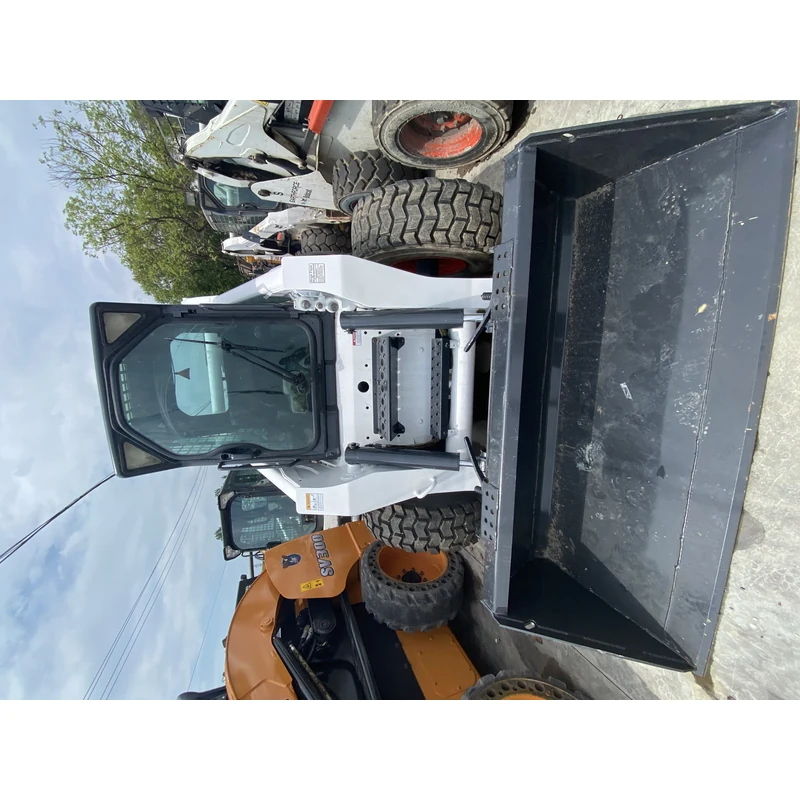
The loader-arm decal is the fastest confirmation that a used machine carries the high-flow option. Photograph taken at HCQ Machinery, Hefei.
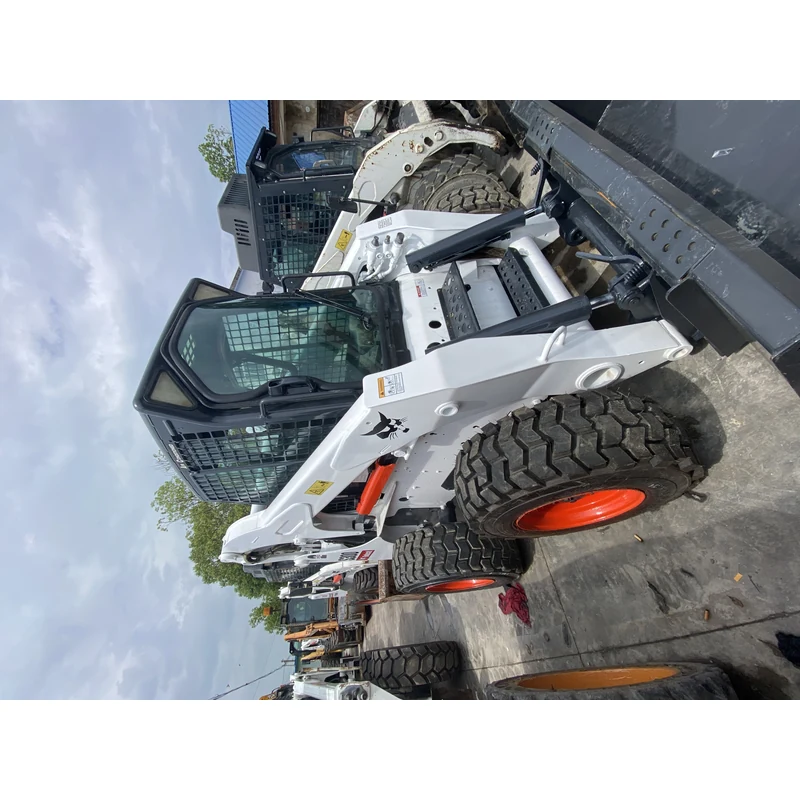
An enclosed cab with air conditioning is a separate line item from the loader rating and is confirmed on the machine, not on a specification sheet. Photograph taken at HCQ Machinery, Hefei.
Cab configuration behaves the same way. An enclosed cab with air conditioning, an enclosed cab with heat only, and an open ROPS canopy with mesh screens are three different machines to an operator on a full shift in the Gulf, West Africa or Southeast Asia, and none of the three is identifiable from a specification table.
What the specification sheet cannot tell you
Everything above concerns the rating. Four things decide whether this particular machine is worth its price, and none of them is on any sheet.
The chaincase and final drives come first. Skid steers drive through chains in an oil bath, and chain stretch or a leaking chaincase is expensive and invisible in a photograph of a clean machine. Ask for the oil level and condition at each corner.
The quick-attach plate and loader arm pivots are the honest record of how the machine was used and whether attachments were run hard. Elongated pin bores at the attachment plate tell you more than the hour meter does.
Tyres are a real line item on a wheeled skid steer, and mismatched tyres change how the machine tracks. Photograph all four including the sidewall markings.
Service records and ownership history are the two items every buying guide names, and they remain right. What changes for an export purchase is that you cannot leaf through a folder, so ask for photographs of whatever record exists rather than a description of it.
What to send the seller before you pay a deposit
| Ask | What it settles | A complete answer looks like |
|---|---|---|
| Is your figure rated operating capacity or tipping load, and under which standard (SAE J818 or ISO 14397-1)? | The 2× ambiguity, entirely | “Rated operating capacity per SAE J818, standard bucket, no counterweight” |
| In which configuration was the unit rated: ballast, tyre size, counterweight, reference bucket? | The 12.6% gap that a market label hides | A photograph of the rear of the machine plus the tyre sidewall marking |
| What is the engine model and serial number? | Which generation, and so which flow figure applies | A photograph of the engine nameplate |
| Standard flow or high flow, and what figure? | Which attachments the machine can run at all | A photograph of the loader-arm decal plus the number |
| Hour meter and serial plate in one frame | Ties the hours to this machine rather than to a listing | One image, both legible |
| Chaincase oil condition at each corner, and the quick-attach plate close up | The two most expensive wear items | Four oil-level photographs and two plate close-ups |
If a seller cannot produce the fifth row, that deserves more attention than any number above it. It is a thirty-second photograph of a machine they say is in their yard. What a remote inspection should cover is set out in how to inspect a used machine remotely when buying from China, and the ways hour readings get misrepresented are in excavator hour meter fraud: six warning signs. The meter is the same component on a skid steer.
Once the machine is settled, the destination’s rules decide whether it can land at all, which is a separate exercise covered in used construction equipment import requirements by destination.
Current skid steer stock sits under used loaders, including the Bobcat S300 with air-conditioned cab, the Bobcat S550, the Bobcat S185, the Bobcat S160, the Bobcat S70 and the Case SR175.
Frequently asked
Is rated operating capacity always exactly half the tipping load on a wheeled skid steer? No. The standards cap it at half. Of the wheeled machines above, the S160, the S550 in both configurations and the EU S70 sit at exactly 50.0%, the S300 at 49.1%, the North American S70 at 46.3% and the S185 at 45.4%. Dividing the tipping load yourself gives 2,038 lb for the S185 against Bobcat’s rating of 1,850 lb, an overstatement of 10.2%.
A listing quotes one capacity figure and nothing else. Can I work backwards to the tipping load? Only within a range, and the range is wide enough to matter. If the figure is a wheeled machine’s rating you can say the tipping load is at least twice it, because the rating is capped at half, but it may be more: the S185’s rating implies at least 3,700 lb against a published 4,076 lb. If the machine is rubber-tracked the multiplier is at least 2.86 rather than 2. Working backwards therefore gives you a floor, never the number, which is why the tipping load has to be asked for rather than inferred.
How many hours are too many on a used skid steer? No published threshold exists, and any guide quoting one is quoting an opinion. What is checkable is whether the hours are evidenced, with meter and serial plate in one photograph, and whether wear at the loader arms, quick-attach plate and chaincase is consistent with the reading.
Does any of this apply to a Case, JCB or XCMG skid steer? The method does, because the standards do. ISO 14397-1 and SAE J818 are not brand documents, so the same two questions apply to any wheeled skid steer: which figure is it, and under which cap. What changes is that the published sheets for other brands are laid out differently and some do not print the tipping load at all, in which case the rating cannot be checked and has to be taken on the seller’s word or left alone.
The seller only sent me a photo of the machine and a price. What is the minimum I should get back? Four photographs settle most of it: the serial and data plate with the hour meter in the same frame, the engine nameplate, the loader-arm decals, and the rear of the machine. Between them they fix the model generation, the flow option and whether the counterweight is fitted, which are three of the four variables above.
How this article was produced. The draft was written with AI assistance and reviewed before publication by the HCQ Machinery sales engineering team in Hefei, China, against the sources linked in the body. The ISO 14397-1 definitions and factors quoted above come from the publicly available preview extracts of the 2007 and 2002 editions, which carry clauses 3.1, 3.2, 4.1 and 5.1 together with Table 1; the remainder of the standard sits behind ISO’s paywall and is not quoted. SAE J818 is quoted only as it appears on manufacturer sheets, because its full text is paywalled and we have not read it. Model figures come from Bobcat-authored specification sheets and Bobcat’s own regional websites, linked at each table. Where Bobcat no longer hosts a sheet the linked copy is a third-party mirror of the original and is labelled as one. Two North American figures come from RitchieSpecs and are labelled where used. The photographs are HCQ’s own, taken in our yard, and show machine configuration only. They are not condition reports, and no test or measurement was performed for this article. Specifications are manufacturer published figures; the condition and configuration of any individual machine is confirmed at inspection.
Bobcat® is a registered trademark of Bobcat Company. Case® is a registered trademark of CNH Industrial. Anhui Huachunqiang Machinery Equipment Co., Ltd. is an independent supplier of used construction equipment and is not affiliated with, authorised by, or endorsed by either company.