Jaw vs Cone vs Impact Crusher: Choose by Rock Properties
Release time: 2026-09-11
Published 11 September 2026 · Reviewed by the HCQ Machinery crushing and screening team, Hefei, China
Every crusher comparison you can find sorts rock by its name. Granite is hard, limestone is medium, gravel is easy. Manufacturers do not sort rock that way. They sort it by numbers from laboratory tests, and at least one of them publishes the actual threshold at which a machine type stops being the right answer.
The short answer. Metso publishes a numeric limit for impact crushers: they “perform well in high crushability (> 40 %) i.e. soft rock, and low abrasiveness (< 400 g/ton) applications,” and adds that “compressive crushers don’t have specific rock type limitations.” That single sentence does more work than every hardness adjective in this subject. Two numbers decide the machine: how easily the rock breaks, and how fast it eats metal. Rock names are a shorthand for those numbers, and the shorthand is loose enough to buy the wrong plant with.
The rest of this page is the four measurements those numbers come from, what each one does and does not tell you, and where the published guidance contradicts itself.
The four numbers that actually decide the machine
Crushability, and the work index behind it
Crushability describes how much energy it takes to break the rock. The formal version is the Bond work index. Metso attributes it plainly: “The best known, and probably the most accurate and largely proven is the method developed by F. C. Bond, in the Allis Chalmers test center.”
Its definition is specific and it is worth reading once, because it explains why the number is not a hardness: “This factor expresses in kWh, the value of the work required to reduce the size of a short ton of material with a theoretically infinite feed size to a product with a passing percentage of 80% in a 100 μ sieve.” The energy relation Metso prints is E = 10 × Wi × [1/√P − 1/√F], where E is kWh per short ton, and P and F are the 80%-passing sizes of product and feed in microns. (Metso, Crushing and Screening Handbook, 7th edition, 2023, §3.8, pp. 207-208. Accessed 10 September 2026.)
One caveat on the units, because it is a common error. Bond’s index is usually written kWh/t, and specialists argue it should not be: the index is “related to the rate of change in specific energy consumption for a particular size reduction,” and its technically correct units are kW·h·t⁻¹·µm⁻⁰·⁵. It also matters whether a quoted figure is on a short-ton or metric basis. (Doll & Simonian, “Bond’s Work Index: What It Is and What It Isn’t,” SAG Conference 2019.)
Abrasiveness, and the two different numbers that share the name
This is the trap in the subject. Manufacturers publish two abrasiveness figures with similar names and different units. They are not linearly convertible; what exists is a coarse class-by-class correspondence, printed in the second table below.
Bond abrasion index, Ai. Metso describes it as “a parameter showing the abrasion power of a material, normally proportional to the percentage of free silica content,” measured in a rotating drum with a standard steel paddle, where “the abrasion index is numerically equal to the weight loss (grams) of the plate.” It is a mass in grams. Metso’s own lab-test table lists it as “Paddle Abrasion Index Ai”, records it as an industry standard, and notes it is “also called Bond abrasion.”
French abrasiveness, ABR. A different test to AFNOR NF P18-579, run in a 90 mm bowl at 4,500 rpm for five minutes, reported in grams per tonne.
Metso’s threshold for impact crushers, the “< 400 g/ton” above, carries the g/ton unit, which is the ABR unit; Ai is reported in grams. Metso does not label that threshold explicitly, so this is an inference from the unit rather than a statement by Metso, and it is the reading the abrasiveness table supports: 400 g/t falls inside “slightly abrasive”, whereas 400 on the Ai scale is off the top of it. Read that number as an Ai figure and the guidance inverts.
Compressive strength
Uniaxial compressive strength is what most people mean when they say a rock is hard. The test standard is ASTM D7012, and it contains four methods that are routinely confused: A and B are triaxial, C and D are unconfined. Method C is the unconfined compressive strength test, and it “requires strength determination only. Strain measurements and a stress-strain curve are not required.” Method D adds Young’s modulus and Poisson’s ratio under unconfined loading.
Worth knowing if you go looking: Metso’s own lab-standards table cites “ASTM D4555:2010” for compressive strength. D4555 is a compressive strength test, so the citation is not a category error, but it is a different test from the one most readers will commission: its title is “Standard Test Method for Determining Deformability and Strength of Weak Rock by an In Situ Uniaxial Compressive Test”, and ASTM withdrew it in 2019. A 2023 handbook citing the 2010 edition of a standard withdrawn in 2019 is worth knowing before you quote it at a laboratory. For a lab test on core, ask for D7012 Method C.
Los Angeles abrasion, which runs the opposite way to everything else
The LA test tumbles aggregate with steel balls and reports what broke down. Under ASTM C131/C131M-20 the result is a percent loss, and the standard describes it as “an indicator of the relative quality or competence of various sources of aggregate.” ASTM C535 covers larger sizes; AASHTO T 96-22 is the same method with modifications.
Because it is a loss, a higher LA number means a weaker rock. That is the reverse of every other number on this page, and it is why LA appears in the “very easy to crush” row of the table below rather than the “very difficult” one.
State highway agencies set LA as a maximum, which is the practical proof of direction. Washington State DOT’s specification requires “Los Angeles Wear, 500 Rev. 30 percent max” for hot mix asphalt, 35% for concrete and crushed surfacing, 40% for ballast and 50% for streambed aggregates. (WSDOT, Standard Specifications, Manual M 41-10, Division 9.) AASHTO T 96 is a test method and sets no acceptance limit of its own, so the widely repeated “DOTs cap LA at 40%” is not a rule anyone publishes; the limit depends on what the aggregate is for.
Mohs hardness, which is not a crusher input
Mohs is the scale everyone reaches for and the one that decides nothing here. There is an ASTM standard with Mohs in the title, ASTM C1895-20, and its scope is “ceramic tile, glass tile, and other hard surfaces.” There is no ASTM, AASHTO or ISO Mohs standard for rock or aggregate.
Metso lists Mohs among rock parameters and then uses crushability, ABR, Ai, work index, LA and UCS for every selection rule, capacity table and wear-part recommendation in the handbook. Mohs appears in none of them. Treat it as a proxy for free silica content when identifying a mineral, not as a number you size a plant with.
The classification table manufacturers actually work from
This pair of tables is the bridge between the different scales, and it is worth more than any rock-name list. Both are from Metso’s handbook, p. 167, reproduced as printed except that the handbook’s open-ended cells are written here with the mathematical symbols they mean: where Metso prints a bare figure followed by a rule, that cell is read as “and above”, and where the rule precedes the figure it is read as “and below”.
Crushability. Note that the fourth column, which Metso heads “Ai” in the original, is an impact index measured on an 8 mm product and is a different quantity from the Bond abrasion index discussed above; it is renamed here to keep the two apart.
| Class | Bond work index (kWh/t) | Crushability (%) | Los Angeles value | Impact index on 8 mm product | Shatter index |
|---|---|---|---|---|---|
| Very easy | 0-7 | ≥ 50 | ≥ 27 | ≥ 60 | ≥ 40 |
| Easy | 7-10 | 40-50 | 22-27 | 45-60 | 35-40 |
| Medium | 10-14 | 30-40 | 17-22 | 30-45 | 30-35 |
| Difficult | 14-18 | 20-30 | 12-17 | 15-30 | 25-30 |
| Very difficult | ≥ 18 | ≤ 20 | ≤ 12 | ≤ 15 | ≤ 25 |
Abrasiveness
| Class | French abrasiveness ABR (g/t) | Bond abrasion index Ai |
|---|---|---|
| Non abrasive | 0-100 | ≤ 0.1 |
| Slightly abrasive | 100-600 | 0.1-0.4 |
| Medium abrasive | 600-1,200 | 0.4-0.6 |
| Abrasive | 1,200-1,700 | 0.6-0.8 |
| Very abrasive | ≥ 1,700 | ≥ 0.8 |
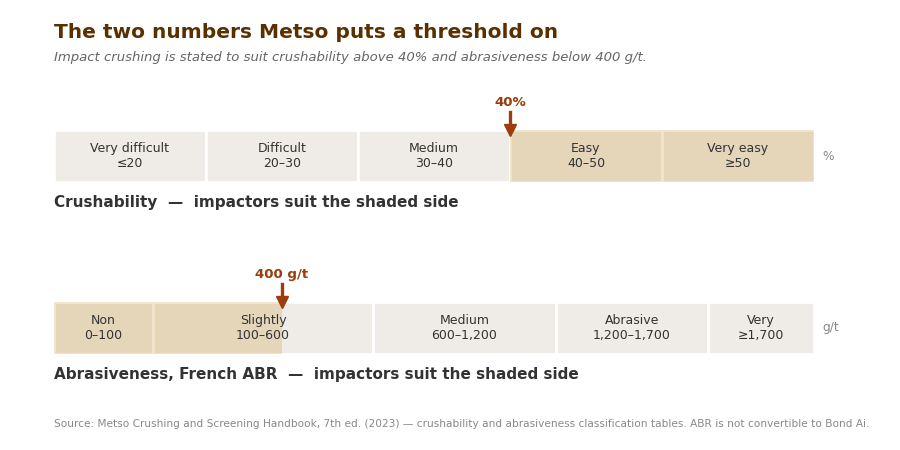
Metso’s crushability and abrasiveness classes, with the two thresholds it states for impact crushing. Source: Metso Crushing and Screening Handbook, 7th ed. (2023).
Read the two together and Metso’s impact-crusher threshold resolves into something you can act on. Crushability above 40% is the “easy” and “very easy” rows. ABR below 400 g/t sits inside “slightly abrasive.” An impactor is being recommended for rock that is easy to break and only mildly abrasive, and the guidance says so in numbers rather than in adjectives.
For rock-type figures, Metso’s minerals table gives abrasion index and compressive strength side by side. Note the unit: the handbook prints compressive strength in Kp/cm², and it is reproduced here rather than converted.
| Rock | Formation | Ai | Compressive strength (Kp/cm²) | Specific weight (t/m³) |
|---|---|---|---|---|
| Basalt | Igneous | 0.2 ± 0.1 | 3,000-4,000 | 2.9-3.0 |
| Diabase | Igneous | 0.3 ± 0.1 | 2,500-3,500 | 2.8-2.9 |
| Gabbro | Igneous | 0.4 | 1,700-3,000 | 2.9-3.0 |
| Andesite | Igneous | 0.5 | 1,700-3,000 | 2.6-2.8 |
| Gneiss | Metamorphic | 0.5 ± 0.1 | 2,000-3,000 | 2.7 |
| Granite | Igneous | 0.55 ± 0.1 | 2,000-3,000 | 2.7 |
| Quartzite | Metamorphic | 0.75 ± 0.1 | 1,500-3,000 | 2.7 |
| Sandstone | Sedimentary | 0.1-0.9 | 300-1,800 | 2.7 |
| Dolomite | Sedimentary | 0.01-0.05 | 500-2,000 | 2.7 |
| Limestone | Sedimentary | 0.001-0.03 | 800-1,800 | 2.7 |
Source: Metso handbook, p. 199, “Mechanical properties of some minerals”. To compare these against strengths quoted in megapascals, multiply Kp/cm² by 0.0981; granite’s 2,000-3,000 Kp/cm² becomes roughly 196-294 MPa.
Two things that table shows and the rock-name shorthand hides. Basalt is stronger than granite in compression but roughly a third as abrasive by Ai, so “hard and abrasive” is doing two different jobs in one phrase. And sandstone spans 0.1 to 0.9 on Ai, which covers four of the five abrasiveness classes in a single rock name; on Metso’s figures a sandstone quarry can sit below granite at 0.55 or above quartzite at 0.75, depending on its cement and silica content.
Two materials are missing from that table and from every acceptable source we searched. There is no published Ai, UCS or LA figure for river gravel as a material class. Metso only remarks that “in the case of gravel, mother nature has done the primary crushing.” For recycled concrete, the only figure we could source is Los Angeles abrasion loss of 20-45% for coarse particles, from an archived FHWA publication, FHWA-RD-97-148, which is around three decades old. If your feed is gravel or recycled concrete, the honest position is that the published tables do not cover you and a sample test is the only way to know.
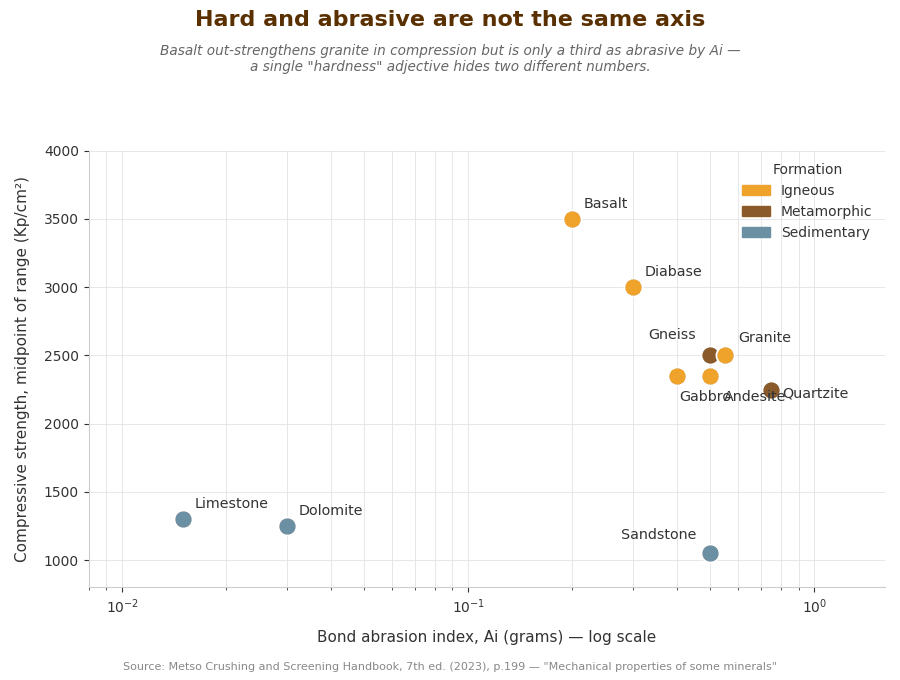
Bond abrasion index (Ai) vs. compressive strength, by rock type. Source: Metso Crushing and Screening Handbook, 7th ed. (2023), p.199.
Reduction ratio, and why nobody should quote you a single number
How much a crusher reduces material in one pass sets how many stages the plant needs. Published figures vary more than most buyers expect, so here are three sources side by side rather than one confident number.
| Crusher | Metso handbook 7th ed., p. 16 | Metso Basics in Minerals Processing ed. 12, p. 29 | Sandvik jaw specification |
|---|---|---|---|
| Primary gyratory | 6-8 | 3-5 (unqualified “gyratory”) | not published |
| Jaw | 3-5 | 3-4 | 1:2 or 1:3 |
| Cone, secondary | 3-4 | 3-5 (unqualified “cone”) | not published |
| Cone, tertiary | 2-3.5 | not published | not published |
| Horizontal shaft impactor | 5-10 | 5-10 | not published |
| Vertical shaft impactor, rock-on-rock | 1-1.5 | 1-2 (unqualified “vertical”) | not published |
| Vertical shaft impactor, rock-on-anvil | 1-2.5 | not published | not published |
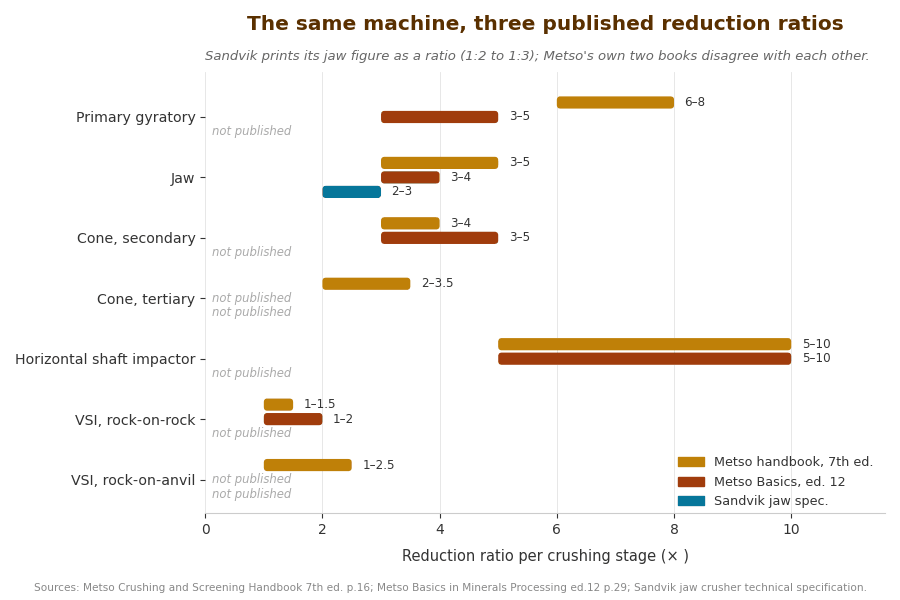
The same crusher, three published reduction ratios. Sources: Metso handbook 7th ed. p.16; Metso Basics ed. 12 p.29; Sandvik jaw specification.
Sources: Metso handbook 7th ed.; Metso, Basics in Minerals Processing, ed. 12, 2021; Sandvik jaw crusher series technical specification. All accessed 10 September 2026.
The jaw row runs from 2 to 5 across three manufacturer documents. The gyratory row is two Metso documents disagreeing with each other, and only part of the gap is explained by one saying “primary gyratory” and the other saying “gyratory.” Sandvik states its own qualifier: the ratio “is affected by the feed material’s bulk density, crushability, size distribution and moisture content”, among other factors.
Metso also gives the reason the numbers move: “The rock crushability has an effect on the expected crusher reduction ratio. The harder the rock, the lower is the reduction ratio in each crushing stage.” A reduction ratio quoted without the rock it was measured on is not a specification.
Feed size against the opening, where the published guidance conflicts
Metso publishes a rule of thumb for primary crushers: “the maximum size of feed material should be in the range of 60 to 80% of the crusher intake opening’s size,” qualified by “the type of feeder used, material flow to the crusher, and the availability of the necessary means (like breakers) to remove large-sized boulders in the event of bridging at the material intake opening.”
Sandvik publishes no percentage. It publishes per-model maximum feed sizes instead, and they sit well above Metso’s range against the narrow dimension of the opening:
| Sandvik model | Feed opening (mm) | Maximum feed size (mm) |
|---|---|---|
| CJ211 | 1,100 × 700 | 630 |
| CJ409 | 895 × 660 | 600 |
| CJ411 | 1,045 × 840 | 750 |
| CJ412 | 1,200 × 830 | 750 |
| CJ612 | 1,200 × 1,100 | 990 |
| CJ613 | 1,300 × 1,070 | 1,070 |
Source: Sandvik jaw crusher series technical specification, p. 2.
Divide each Sandvik maximum by the narrow dimension of its own opening and the ratios run from 89% on the CJ409 to 100% on the CJ613, where the published maximum feed size equals the gape exactly. Those percentages are our arithmetic on Sandvik’s published table, not a Sandvik-published figure, but they show the size of the gap: Metso’s rule of thumb sits 20 to 40 points below the other manufacturer’s stated ceilings. The two are not reconcilable from published text. A reasonable reading is that Metso’s figure is a plant-design margin against bridging while Sandvik’s is a mechanical maximum, but neither company says that, so we are not going to assert it. What is safe to act on: size your primary against Metso’s 60-80% if you are designing a plant that must run unattended, and treat a manufacturer’s per-model maximum as the ceiling rather than the target.
What the manufacturers say about each machine, in their own words
Metso, on impactors: “Impactors are mostly used for nonabrasive materials.” And: “Primary impact crushers are generally used in nonabrasive [applications].” And, for the finishing stage, “clients crushing hard or abrasive materials are advised to install cone crushers for the final crushing and cubicizing stage.”
Metso, on cones: “Cones are performing very well with all kinds of rock types.” The mechanism it credits is interparticle crushing: “An additional crushing effect occurs between the compressed particles, resulting in less wear of the liners.”
Metso, on vertical shaft impactors, which is the one exception to the abrasiveness rule: “For good shape requirement, rock-on-rock VSI crusher is performing well in all kinds of applications regardless of the high abrasiveness. The maximum feed size is limiting the use of rock-on-rock VSI crusher.”
That last quote is the useful nuance the comparison articles miss. Impact crushing is not ruled out on abrasive rock in general. It is ruled out where the abrasive rock hits metal. A rock-on-rock VSI protects itself with a bed of the same material, which is why it survives feed that would destroy a horizontal-shaft impactor’s blow bars.
The cone’s requirement is equally specific and equally often ignored. Metso’s rule is that the cavity should be kept as full of rock as possible, quoted in full in what a crusher’s TPH figure actually assumes, and its own list of conditions for good cubical product asks for “material below setting in the feed 10-30% (but no filler and fines 0-4 mm normally)” and feed distribution that “should be non-segregated and evenly distributed around crushing cavity.” A cone fed intermittently from a truck is not being run the way its capacity was measured.
Putting it together
| If the rock is | Primary | Secondary and tertiary | Why |
|---|---|---|---|
| Crushability under 40% and ABR above 400 g/t (hard, abrasive: granite, quartzite, high-silica sandstone) | Jaw or primary gyratory | Cone | Metso: impactors are for high crushability and low abrasiveness; compressive crushers have no stated rock-type limitation |
| Crushability above 40% and ABR below 400 g/t (soft, non-abrasive: most limestone, dolomite) | Jaw or primary impactor | Impactor | Metso states impactors perform well in exactly this window, and they give better shape and higher reduction per stage |
| Abrasive but shape is critical | Jaw | Cone, then rock-on-rock VSI | Metso: rock-on-rock VSI performs “regardless of the high abrasiveness”, limited by maximum feed size |
| Unknown, or gravel, or recycled concrete | Test before you buy | Test before you buy | No published property table covers gravel; the only recycled-concrete figure we could source is a three-decade-old LA range |
One more thing worth quoting, because it is the manufacturer arguing against over-reading its own tables: “When measuring rock properties, the sampling action and the sample preparing are very decisive reasons for the results. In these laboratory tests the size of the sample is always small and the results are valid only for the sample.” Two samples from opposite ends of one quarry can land in different rows of the crushability table. The numbers are how you narrow the choice, not how you finish it.
If you are working out what a machine will actually produce once you have chosen the type, that is a separate calculation with its own published assumptions, and it is set out in what a crusher’s TPH figure actually assumes. The wear consequences of feeding the wrong rock to the wrong chamber are in crusher wear parts and what actually drives liner life. And if the machine you are considering is second-hand, the wear parts on it already record which of these rules its last owner followed, which is the starting point of inspecting a used mobile crushing plant.
Current jaw, cone and screening plants are listed under stone crushers, including the Komatsu BR1000JG crawler jaw crusher and the J10H mobile jaw crusher.
Frequently asked
Which crusher is best for granite? By Metso’s published figures granite sits at Ai 0.55 ± 0.1 and 2,000-3,000 Kp/cm² compressive strength, which is abrasive enough that Metso’s own guidance points away from horizontal-shaft impactors and toward compressive crushing: a jaw or primary gyratory followed by cones. If cubical shape matters, a rock-on-rock VSI is the exception, because Metso states it works “regardless of the high abrasiveness.”
Is a higher Los Angeles abrasion number better or worse? Worse. The result is a percentage lost during the test, so a high number means more of the sample broke down. WSDOT allows 30% for hot mix asphalt and up to 50% for streambed aggregate, always written as a maximum.
Can I use Mohs hardness to choose a crusher? Not usefully. The only ASTM standard with Mohs in the title covers ceramic and glass tile, and Metso’s handbook uses crushability, abrasiveness, work index, LA and compressive strength for every actual selection rule while using Mohs for none of them.
Why do two suppliers quote different reduction ratios for the same crusher type? Because they publish different figures. For jaws, Sandvik prints 1:2 to 1:3, Metso’s Basics prints 3-4 and Metso’s Crushing and Screening Handbook prints 3-5. Metso also notes that harder rock lowers the achievable ratio in every stage, so a ratio quoted without the test material behind it is not comparable.
What if my feed is river gravel or recycled concrete? The published property tables do not cover either. We could find no acceptable source giving UCS, LA or abrasion index for river gravel as a class, and for recycled concrete only an LA range of 20-45% in an archived FHWA document. Send a sample for testing rather than reasoning from a rock name.