


Crusher Wear Parts: What Actually Drives Liner Life
Release time: 2026-09-13
Published 13 September 2026. Technical review: HCQ Machinery crushing and screening team, Hefei, China.
Manganese steel liners do not arrive hard. They have to be beaten hard by the rock, and if the rock cannot do it, the liner never reaches the property you paid for. Superior Industries puts the commercial consequence bluntly: an operator whose material “is not hard enough to work harden the liners” could, in its words, “simply be throwing money away.”
The short answer. A manganese liner works because its surface hardens under impact while its core stays soft. Terex publishes how thin that hardened surface is: “at any given time the work hardened face is only about 2-3mm.” Everything that shortens liner life either stops the surface hardening or grinds it away faster than it forms, and the four usual causes are the wrong alloy for the feed, a chamber that is not kept full, too many fines, and a setting so tight the liner never gets the impact it needs.
This page quotes the manufacturers’ own application guides rather than the aftermarket foundries that dominate this search. That distinction matters more here than in most subjects, because the foundries sell the parts.
What manganese steel actually is, and what the shorthand gets wrong
The specification is ASTM A128/A128M-19(2025), “Standard Specification for Steel Castings, Austenitic Manganese”. Its abstract: “This specification covers Hadfield austenitic manganese steel castings and alloy modifications. The castings shall be suitably heat treated to achieve toughness and ductility.”
Note what the standard says the heat treatment is for. Not hardness. Toughness and ductility. The hardness comes later, from the rock.
The international specification is ISO 13521, “Austenitic manganese steel castings”, currently in its third edition of 2023. Its grade designations are worth reading, because the number after “Mn” in each one is the nominal manganese content:
| ISO 13521 designations, 1999 edition |
|---|
| GX120MnMo7-1 |
| GX100Mn13, GX120Mn13, GX110MnMo13-1, GX120MnCr13-2, GX120MnNi13-3 |
| GX90MnMo14 |
| GX120Mn17, GX120MnCr17-2 |
Source: ISO 13521:1999 published preview, the edition whose grade list is publicly readable. The 2023 edition is current and its grade list is behind ISO’s paywall, so treat this list as the 1999 set rather than today’s. Composition ranges are not reproduced here: the public preview’s table did not extract reliably, and a manganese range printed from an unreliable read has no business in a section about specification precision. Ask the foundry for the composition against the edition they cast to.
On the “Mn13 / Mn18 / Mn22” shorthand, be precise about which part is wrong. Grades at nominal 13 and 17 do exist as designations, so “Mn13” maps onto something real. “Mn18” does not appear as a designation, though it sits inside the family the 17-series belongs to. “Mn22” corresponds to no ISO designation at all. Where higher-manganese products exist they are proprietary and their makers say so: Columbia Steel describes its Xtralloy as 24% manganese and “significantly higher in carbon and manganese content than conventional Hadfield’s manganese steel.” (Columbia Steel.) Buying “Mn22” is buying a supplier’s product rather than a specified grade, so ask which standard and which edition it is cast and heat treated to. ASTM A128 has its own grade letters, A through F, which are the designations to ask for if the casting is specified to the ASTM standard rather than the ISO one.
Work hardening, in the manufacturer’s words and the metallurgist’s
Terex publishes the clearest plain-language account we found:
“Work hardening of a jaw liner, is the strengthening of the liner as it is pounded by rock forces inside the crushing chamber.”
“Before work hardening, the molecular structure of the liner is a regular, defect-free pattern. As the liner is pounded by rock, the microstructure dislocates and the structure becomes denser.”
“For manganese to work the skin has to be very hard and abrasive resistant but the core needs to be as ductile and as soft as chewing gum.”
“If manganese is misapplied, there is a serious risk of losing this innate ductility that must be at the core.”
(Terex, Crusher Wear Parts Reference Guide, EvoQuip, April 2018. Accessed 10 September 2026.)
The number that changes how you think about the part is this one: “Liners work harden by compressive forces and at any given time the work hardened face is only about 2-3mm.” A jaw die is not a hard component. It is a soft component wearing a two-millimetre hard skin that is continuously destroyed and continuously remade. Anything that stops it being remade removes the property rather than merely some of the life, and the three usual culprits are too little impact, too fine a feed, and a chamber that is not kept full.
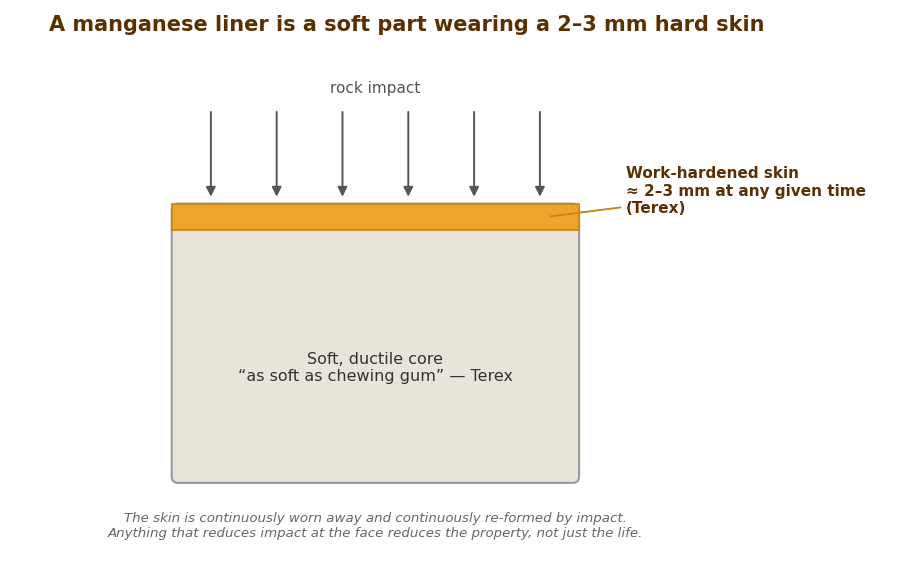
A manganese liner is a soft part wearing a 2-3 mm hard skin, continuously worn away and re-formed by impact. Source: Terex EvoQuip Crusher Wear Parts Reference Guide, 2018.
The mechanism, where the internet is wrong
Almost every online explanation attributes manganese work hardening to mechanical twinning. The peer-reviewed study usually credited for the explanation says the opposite. Dastur and Leslie tested it directly: at −50 °C twins formed abundantly yet hardening was minimal, and above 225 °C no twins formed despite significant hardening. Their conclusion is that “dynamic strain aging, brought about by the reorientation of carbon members of C-Mn couples in the cores of dislocations, is the principal cause of rapid work hardening in Hadfield steel.” (Dastur, Y. N. & Leslie, W. C., Metallurgical Transactions A, Vol. 12, No. 5, 1981, pp. 749-759.)
This does not change what you buy. It does tell you which sources have read anything primary.
Choosing the manganese percentage, including where the guidance contradicts itself
Terex’s published selection guidance for jaw liners:
| Grade | Terex’s stated use |
|---|---|
| 14% Mn | “This is an option and is ordered in on demand. For use in soft low abrasion applications.” |
| 18% Mn | “Standard fit on all jaw crushers. This is a liner suitable for all applications.” |
| 22% Mn | “Optional fit for all jaw crushers. Hardens quicker in abrasive applications.” |
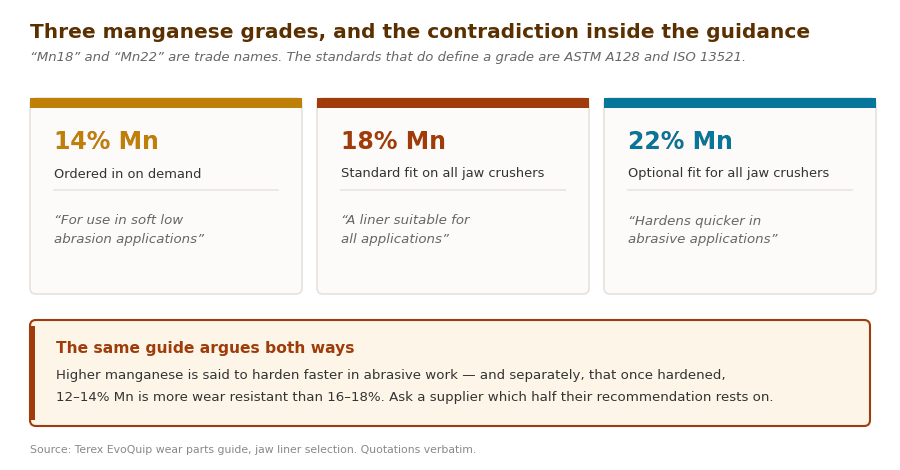
Terex’s stated use for each manganese grade, and the contradiction inside the same guidance. Source: Terex EvoQuip wear parts guide.
The same guide also states: “The work hardened face has a higher [Brinell] value if the percentage of manganese content is lower. For example, once work hardened, steel with 12-14% manganese content will be more wear resistant than steel with 16-18% content.” And, separately: “The speed at which the liner work hardens increases as the percentage of manganese content increases.”
Those two sentences pull in opposite directions and both are Terex’s. Read together they would mean that higher manganese hardens faster while lower manganese finishes harder, which would turn the choice into a question of whether your feed can harden a low-manganese liner at all before it wears through. Terex does not say that, and neither will we: it is a reading, not published guidance, and no manufacturer we could reach states it.
What you can do with the contradiction is use it as a question. When a supplier recommends a manganese percentage, ask which of the two effects the recommendation rests on, hardening speed or final hardness. A supplier working from the application rather than from stock will have an answer.
One thing we could not find published: searching the public application guides and technical pages of Metso, Sandvik, Terex, Kleemann and Astec, we found no manufacturer guidance recommending chrome-moly or martensitic alternatives for jaw or cone liners. Terex’s guide offers no non-manganese jaw option at all. Metso’s only jaw alternative is a hybrid: “The MX jaw is a hybrid product, in which the manganese steel acts as the matrix and the wear surface is covered by Metso’s special wear-resistant material.” Metso’s cone guides name material codes without publishing their metallurgy. If a supplier offers you a chrome jaw die, the burden is on them to produce the OEM guidance for it.
Blow bars, where the alloy choice is genuinely dangerous to get wrong
Impactor blow bars are the one wear part where the wrong alloy does not just wear out. It breaks. Metso’s application guide is explicit about which alloy tolerates tramp iron and which does not.
| Alloy family | Metso’s published guidance |
|---|---|
| Manganese (XT510) | “used in primary crushers or in crushers that have tramp iron in the feed”; “Manganese steels are used whenever very high shock resistance or some elongation is needed” |
| Martensitic | “used whenever hardness and impact resistance are both needed, i.e. in all the applications where usage of white (chromium) irons can lead to breakage”; “martensitic steel has a longer lifetime than manganese steels in more abrasive applications when the feed size is below 900 mm” |
| White cast iron (chromium) | “White irons are used when the shock level is rather low and the castings rather thick”; “used in secondary, tertiary and asphalt recycling applications where there is no tramp iron”; “Because of the brittle nature of this alloy, tramp iron will cause catastrophic failure of the blow bars“ |
| Ceramic metal matrix composite | “Metal Matrix Composite (MMC) is a metallic matrix (steel or cast iron) and ceramic alloy”; “These blow bars can have two to four times the life of standard mono-alloy blow bars” |
Source: Metso, Nordberg NP Series impact crusher wear parts application guide, doc. 2757-10-21-EN-CNS, 2021. Accessed 10 September 2026.
Terex states the underlying trade in one sentence: “An increase in Steels Wear Resistance (hardness) such as Chrome, is normally associated with a reduction in toughness (the impact resistance) of the material.”
Two practical rules from the same guides. Blow bars can be turned, once: “Blow bars are reversible. When one face is used, the blow bar can be turned around to use the other face. This procedure can only be done once.” And they have a published wear limit: “Blow bars should be replaced before they are worn through. The wear limit ‘D’ is shown in the illustration,” which Metso gives as 50-80 mm depending on crusher size.
Reading a worn part back to an operating fault
This is the most useful table in either manufacturer’s guide and it appears on no page currently ranking for this subject. Terex publishes what each blow bar wear shape tells you about how the machine was run.
| Wear pattern on the blow bar | What Terex says it means |
|---|---|
| Gentle radius | Correct feed size, rotor penetration and speed |
| Excessive penetration into the bar | “The rotor speed is too slow”; “Increases risk of blow bar breakage” |
| Flat worn top | “The rotor speed is too high”; “Wear rates will be excessive, Reduced output, Creates lot of fines” |
| Wear concentrated at the centre | “A trickle feed gives uneven wear” |
| Wear at both ends | “High percentage of fines in the feed or overfeed causing fines to be pushed to outside” |
| Wear on one side only | “Machine on uneven ground”, with material falling to one side; “Machine isn’t choke fed”; feed dropped onto one side of the feeder when using the recirculating option |
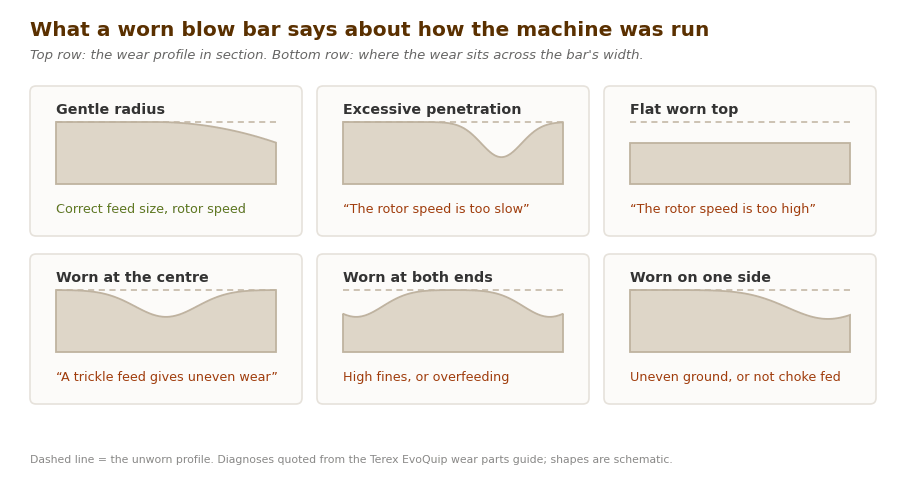
Six blow bar wear profiles and the operating fault each one names. Source: Terex EvoQuip wear parts guide.
Source: Terex EvoQuip wear parts guide, 2018.
Metso’s equivalent for compressive crushers is shorter but points the same way: “Incorrect feeding or feed gradation can lead to distorted wear profiles”; “Unevenly worn blow bars may decrease production”; and for jaws, “An uneven wear profile will decrease capacity, increase wear, and increase crushing forces.”
This is worth doing before you order replacements. A liner set that wore out in half the expected life has a shape, and the shape names the fault. Replacing the part without changing the cause buys the same result again.
The four things that actually change liner life
Fines in the feed
Metso, on jaws: “Fines in the jaw crusher increase the percentage of contact area against the jaw dies. This increases scratching and grinding and reduces life time.” Terex recommends the structural fix: “All crushers work best with a uniform feed gradation and a wide range of material size. Fines do not need to be crushed and so it is normal to use a Vibrating Grizzly Feeder (VGF) so that material smaller than the grizzly aperture bypasses the crushing chamber. This reduces wear on the jaw liners.“
Choke feeding, with the levels published
The rule itself, and what it does to throughput, is covered in what a crusher’s TPH figure actually assumes. What matters here is the wear consequence, which Metso states directly: “Choke feeding maximizes the amount of multi-layer crushing, and improves wear shape and crushing efficiency.” The wear-parts guides also give actual levels rather than an instruction to keep it full: for an HP cone, “300 mm or more above the feed plate”; for a GP secondary, at the mantle fixing nut level.
Feed distribution
Metso: “Feed should not be segregated (for example finer material on one side of the chamber and coarser material on the other side of the chamber),” because “uneven feed distribution may cause unbalanced crushing forces and uneven wearing in the GP concave,” and “a distorted wear profile may decrease capacity, increase the liner wear rate and increase the crushing force.”
Closed side setting, including one single-source recommendation
CSS is, in Metso’s phrase, “the most important crusher parameter,” and it moves three things together: “Larger setting -> Product size increases / Larger setting -> Capacity increases / Larger setting -> Power draw decreases.”
Terex adds a run-in recommendation we found in no other manufacturer’s guidance, so it is attributed rather than generalised: “Tight Closed Side Settings (CSS) can hinder the liners ability to sufficiently work harden. By initially running the chamber at a larger CSS for a day or two this could help increase liner wear life.” That follows directly from the 2-3 mm hardened skin: a setting so tight that the liner is being ground rather than struck never lets the skin form.
When to turn a jaw die, and when to change a cone liner
Both are published, and both are cheaper than the alternative.
Jaw dies. Metso: “rotate the single-piece jaw dies when 30% of the tooth profile is worn,” and “rotate a second time when the tooth profile at the bottom of the jaw die is completely worn.” For two-piece dies there is a detail that saves a part: “work hardened upper jaw dies are installed at the bottom.” (Metso, C Series jaw crusher wear parts handbook, doc. 3795-10-18, 2018.)
Cone liners. Metso: “Liners must be changed before they are worn through… Liners should be changed no later than when the A dimension is 10-15 mm depending on crusher model.” Note what that says: the figure is model-specific and 10-15 mm is the range across models, not an acceptance criterion for yours. Ask for the figure for your model. (Metso GP series wear parts application guide, document 2601-08-23-EN-CNS. Cited by Metso document number: this guide is distributed through Metso’s sales channels and we could not retrieve a stable public URL for it, unlike the C Series and NP Series guides linked elsewhere on this page.)
The number this page will not give you
Wear cost per tonne crushed is the figure every buyer wants and no manufacturer publishes.
Metso’s own handbook comes closest and then stops: its cavity-loading table on page 17 uses “Wear part consumption/g/ton” as a row label and fills the row with directional arrows rather than values. Its cost-component list on page 36 names capital, energy, maintenance, wear parts, labour, drilling and transport, with no percentages against any of them.
The only share figure we could source is narrow and must not be widened: “The blow bar is the component of an impact crusher that is most strongly subjected to mechanical stress. It accounts for 60-70% of the wear costs.” That is a share of wear cost inside a horizontal-shaft impactor. It is not a share of total crushing cost, and it says nothing about jaws or cones. Metso adds, in the same guide, that “the blow bar life is not easily predictable and depends on many factors.”
Grams-per-tonne figures circulate widely. Each one we followed led to a foundry marketing page, a wear-part reseller or a content site rather than to a manufacturer handbook or a paper, so this page prints none. That is a statement about what we could reach, not proof that no such measurement exists. If a supplier quotes you a wear cost per tonne, the reasonable question is which measured job it came from and on what rock.
Before you buy a set of liners
| Ask | Why it matters |
|---|---|
| Which standard is this cast and heat treated to, ASTM A128 or ISO 13521, and which grade? | “Mn18” and “Mn22” are trade names, not grade designations |
| What manganese percentage, and is the recommendation based on hardening speed or final hardness? | The published guidance points both ways and suppliers quote whichever half suits |
| For blow bars: is there tramp iron in my feed? | Metso: white iron suffers “catastrophic failure” with tramp iron; manganese is what tolerates it |
| Can you look at photographs of my worn set before quoting? | The wear shape names the operating fault, and a new set will repeat it otherwise |
| What is the published change or rotation point for this part? | Jaw dies rotate at 30% tooth profile worn; cone liners change at an A dimension of 10-15 mm |
If liners are wearing faster than expected, the cause is usually upstream of the liner, and the two most likely places to look are the feed gradation and how full the chamber is kept. Both are set by choices made when the plant was specified, which is covered in what a crusher’s TPH figure actually assumes, and by whether the machine type suits the rock at all, covered in jaw vs cone vs impact crusher. If you are looking at a second-hand plant, the state of its wear parts is the first invoice you will receive, and reading it is covered in inspecting a used mobile crushing plant.
Machines in stock are listed under stone crushers.
Frequently asked
How thick is the work-hardened layer on a manganese liner? Terex publishes it as “only about 2-3mm” at any given time. It is continuously worn away and continuously reformed, which is why anything that reduces impact at the liner face reduces the property rather than merely the life.
Is more manganese always better? Terex’s own guide argues both ways: it says higher manganese hardens faster and recommends 22% for abrasive work, while also stating that once hardened, 12-14% manganese is more wear resistant than 16-18%. Ask a supplier which of those two statements their recommendation rests on.
Which blow bar alloy for recycled concrete? Metso lists asphalt recycling among the applications for white iron, but conditions it on there being no tramp iron, and states that tramp iron causes “catastrophic failure” of that alloy. Demolition feed frequently contains rebar, which points to manganese or martensitic rather than white iron.
When should I turn a jaw die rather than replace it? Metso’s published point is 30% of the tooth profile worn, with a second rotation when the tooth profile at the bottom is completely worn. On two-piece dies it also recommends installing the work-hardened upper die at the bottom.
A note on sources
The rule this page follows is that no aftermarket foundry or wear-part reseller is used as a source, because they sell the parts the article is about, and they are also most of what ranks for this subject. Selection, wear-pattern and change-point guidance is quoted from the manufacturers’ own application guides. Standards are cited by designation and title; composition ranges are not reproduced, for the reason given in the first section.
Where a manufacturer contradicts itself, as Terex does on manganese percentage, both statements are printed and neither is resolved on the reader’s behalf.

