What a Crusher’s TPH Figure Actually Assumes
Release time: 2026-09-12
Published 12 September 2026. Reviewed before publication by HCQ Machinery’s crushing and screening team in Hefei, China.
A 200 t/h crusher does not produce 200 tonnes an hour. It produced 200 tonnes an hour of one specific material, under conditions the manufacturer prints in small type next to the table, and the gap between those conditions and your quarry is most of the reason plants underperform their brochures.
The short answer. Two of the biggest crusher manufacturers publish the same assumption behind their capacity tables: a bulk density of 1.6 t/m³. One of them adds that the reference material is clean, friable, dry granite with a solid density of 2.65 g/cm³. Every published tonnage is anchored to that. On top of it sits a list of twelve conditions the manufacturer says will change the result, and an ordinary quarry breaks several of them before lunch. Neither manufacturer states, in the capacity notes we examined, whether the figure is open or closed circuit, which is why plant-level arithmetic built on a single crusher’s rating is unreliable.
The assumption both manufacturers print
Metso, introducing its performance tables: “The production capacities given in the performance tables on the pages that follow was prepared as a tool to aid in the correct use of the crushers. The capacities (t/h) indicated are based on materials with a bulk density of 1,600 kg/m³.” (Metso, Crushing and Screening Handbook, 7th edition, 2023, p. 53. Accessed 10 September 2026.)
Sandvik, printed twice, on both of its capacity pages: “Capacity figures apply for clean, friable and dry granite with a bulk density of 1.6 t/m³ (100 lbs./cu.ft.) or compact density 2.65 g/cm³.” (Sandvik jaw crusher series technical specification, pp. 3-4. Accessed 10 September 2026.)
Two independent manufacturers, the same number. That makes 1.6 t/m³ the industry reference basis rather than one company’s convention, and it gives you the first correction to make: a crusher is a volumetric machine, so if your material’s loose bulk density is materially different from 1.6, the tonnage moves with it even when nothing else changes.
Sandvik’s second clause matters as much as the first. “Clean, friable and dry” removes, in five words, the three things that most often reduce real output: fines, clay and moisture.
The conditions Metso says must hold
Metso prints these as “For good performance, all the factors below should be considered.” Reproduced as published:
- Selection of an appropriate crushing chamber for the material.
- Feed curve with adequate size distribution.
- Feed rate control.
- Adequate material distribution over the 360° of the crushing chamber in the case of cone crushers.
- Appropriate dimensioning of the discharge conveyor as regards crushers’ maximum capacity.
- Correct dimensioning of scalping and classifying screens in closed circuits.
- Automation.
- Adequate crusher discharge area.
And the twelve that break it
Metso prints these as factors “when not taken into consideration, may affect the capacity and the performance of the crusher.” Also as published:
| # | Condition that reduces the quoted capacity |
|---|---|
| 1 | Presence of sticky material in the crushers’ feed |
| 2 | Presence of fines in the feed (0-5 mm) exceeding 10% of the crusher capacity |
| 3 | Excessive humidity |
| 4 | Segregation of feed in the crushing chamber |
| 5 | Uneven distribution of feed around the crushing chamber, in the case of cone crushers |
| 6 | Lack of feed control |
| 7 | Wrong motor size |
| 8 | Insufficient capacity of the crusher’s discharge conveyor |
| 9 | Insufficient capacity of scalping and/or circuit closing screens |
| 10 | Insufficient crusher discharge area |
| 11 | Material for crushing being extremely difficult to crush or hard |
| 12 | Crusher operating at a rotation speed below specifications |
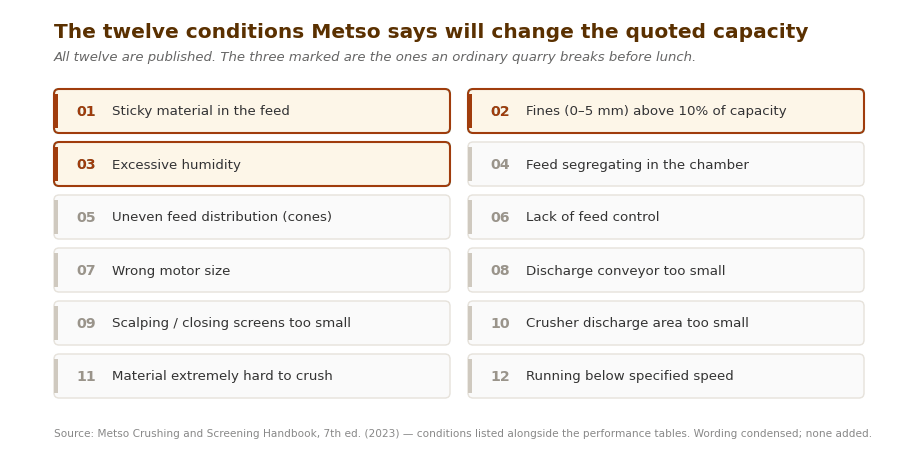
The twelve conditions Metso lists as changing a quoted capacity. Source: Metso Crushing and Screening Handbook, 7th ed. (2023).
Source: Metso handbook, p. 53.
Item 2 is the one worth pausing on, because it is quantified. Fines below 5 mm exceeding 10% of the crusher’s capacity is a condition, not a nuisance. That is the whole argument for a scalping screen ahead of the primary: material that is already smaller than the product size takes up chamber volume, and chamber volume is what the rating measures.
Metso is also explicit that the crusher is not the plant: “The crusher is only one component of the crushing circuit. Therefore, its performance will also depend on the right choice and correct operation of feeders, conveyors, screens, frames, electric motors, drives, and silos.” Several of the twelve conditions above name equipment other than the crusher: the discharge conveyor, the scalping and circuit-closing screens, and the motor.
Closed side setting is the lever, and manufacturers publish the numbers
Closed side setting is “the minimum distance between the liner and concave at the discharge end of the cavity.” Open side setting is the maximum. The difference between them is the stroke. Metso’s glossary defines all three.
Two things move with CSS at once. Metso on product: hydraulic setting adjustment “adjusts the crusher c.s.s. and thus affects onto the product gradation.” Metso on throughput: “In addition to c.s.s., eccentricity is one of the major factors that determine the capacity of gyratory and cone crushers.”
Sandvik publishes it as a table rather than a sentence. For the CJ409 jaw:
| Closed side setting | Capacity (mtph) |
|---|---|
| 50 mm | 85-115 |
| 75 mm | 100-160 |
| 100 mm | 125-200 |
| 125 mm | 150-235 |
Source: Sandvik jaw crusher series technical specification, p. 3.
Opening the setting from 50 mm to 125 mm roughly doubles the throughput and coarsens the product. That is the trade every plant makes, and it is why a tonnage quoted without its CSS is not a number you can use.
The range inside each row has its own meaning, which Sandvik states: “The left figures refer to fines removed from feed and the right refers to fines included in the feed.” So even within one setting, the published spread is a scalping question.
Sandvik also prints a warning that gets skipped, and it bears directly on item 7 in Metso’s list: “for harder materials, the crusher will have to be operated at larger settings to avoid overload of drive and/or motor. Using oversized motors will lead to radically shorter crusher life and various mechanical problems. Warranty will not cover this!” Solving a hard-rock capacity shortfall by fitting a bigger motor is a documented way to void the warranty.
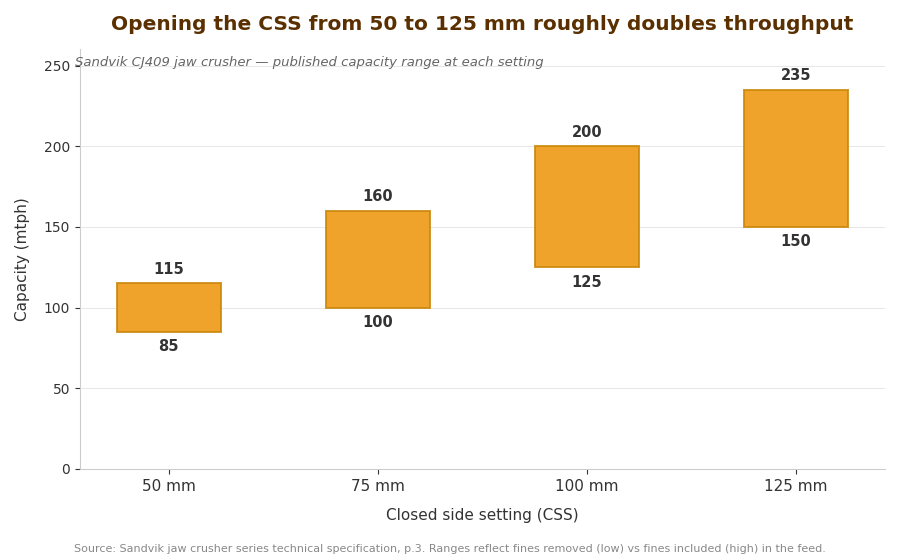
Closed side setting vs. published capacity, Sandvik CJ409 jaw crusher. Source: Sandvik jaw crusher series technical specification, p.3.
The choke point, and why a cone must be kept full
Metso’s glossary defines the choke point as “the point in the crushing cavity where the volume of material to be crushed is smallest,” and then states its consequence directly: “This determines the capacity of the crusher.“
That is the physical reason behind the choke-feeding rule: “as a rule of thumb it is recommended that cones always be choke-fed, meaning that the cavity should be as full of rock material as possible.” Metso quantifies the loading it means: “100% load refers to volumetric capacity. When crusher loading is 100%, cavity is full and throughput is at its maximum.”
The practical fix Metso recommends is not a bigger crusher: “This can be easily achieved by using a stockpile or a silo to regulate the inevitable fluctuation of feed material flow.” A cone fed straight from an excavator bucket is being asked to produce a table figure under conditions the table did not assume.
The stage-loading rule most plants have never seen
This is the single most useful published figure for anyone sizing a multi-stage plant, and it does not appear on any page currently ranking for this subject.
Metso: “As a rule of thumb, final crushing stage should be kept under 100% load all the time. Loading on the secondary crushing state should be about 80% and primary stage about 70%. This gives some extra capacity to the early stages of the crushing circuit to handle the interruptions caused by feed variation. 100% load on final crushing stage, gives control over the products and probability to good product shape.” (Metso handbook, p. 16.)
Read that against a spreadsheet built by multiplying nameplate capacities together and the mismatch is obvious. The manufacturer is telling you to deliberately under-load the front of the plant so the back of it can run full. A plant designed with every stage at 100% on paper is a plant that will surge and starve in practice.
What nobody publishes, and why that matters
Two gaps are worth stating plainly, because they are the reason plant-level arithmetic from a single crusher rating goes wrong.
Neither manufacturer says whether the quoted capacity is open or closed circuit. We searched Metso’s capacity-basis note and Sandvik’s capacity pages, and neither states it. Since a closed circuit returns oversize to the same crusher, the same machine handles more tonnes per hour of crusher throughput than it delivers of saleable product, and without knowing which one a figure refers to, the two cannot be compared.
No published figure exists for circulating load in a closed crushing circuit. Metso defines the circuit as “a crushing process feature, in which part of the material produced by the crusher is circulated back to the same crusher for further crushing”, and states qualitatively that harder feed increases it: “Harder material turns crusher product coarser, which increases the load of the closed circuits.” But no percentage, and no statement of what it does to apparent plant throughput, appears in either of the two Metso handbooks searched for this article. Figures do circulate online. None that we found traces to a manufacturer or a paper, so this page does not print one, and the honest description of that is a gap in what we could reach rather than proof that no such figure has ever been published.
The screens decide as much as the crushers
Metso’s own list puts screen dimensioning in both the good-performance list and the failure list. Two published numbers make screening decisions concrete.
Bed depth. “In an optimal situation, bed depth (d) at feed end of a screen is about 5-7× opening size allowing acceptable feeding capacity and quick stratification.” Too deep and material never reaches the surface; too thin and “material layer to become too thin to keep particle movement in control.”
Critical class. Particles between half and one and a half times the aperture are the ones that cause trouble: “Particles of 0.5a < di < 1.5a are called ‘critical class’. They affect screening performance significantly.” Above the aperture they have “zero passing probability, but these particles tend to block openings preventing smaller particles from” passing. If your feed is concentrated near the cut size, a bigger screen is not the answer; a different cut is.
Two more that change how a screen is specified. Effective open area, not nominal, governs: “The higher the effective open area %, the more probable a particle lands on an opening and potentially pass through.” And amplitude and speed trade against opening size: “Larger openings: higher amplitude, lower speed. Smaller openings: lower amplitude, higher speed.”
Metso’s closing caveat on the whole subject is worth keeping: “In practice, screening efficiency is only an indicative value.”
One definition most of the internet has backwards
Metso defines screening by duty, and its definition of scalping is not the one in general circulation:
| Duty | Metso’s definition |
|---|---|
| Scalping | “To prevent undersize in the feed from blocking the next size reduction stage” |
| Circuit sizing | “To prevent oversize from moving into the next size reduction or operation stage” |
| Product sizing | “To prepare a sized product” |
Source: Metso, Basics in Minerals Processing, edition 12, §4.2, pp. 82-83.
The common formulation, that a scalper removes oversize, is the opposite of what Metso publishes for the scalping duty. In practice a grizzly scalper ahead of a primary does both jobs, bypassing fines and rejecting tramp oversize, but if you are reading a manufacturer’s capacity note, read scalping as Metso defines it: it is there to keep material that does not need crushing out of the chamber. Which loops back to invalidating condition number 2.
Turning a brochure figure into a plant figure
One correction is genuinely supported by the published basis, and it is the density one. Because both manufacturers state that their tables assume 1.6 t/m3, and because a crusher fills a volume rather than a mass, a first-order correction follows directly:
corrected t/h ≈ nameplate t/h × (your loose bulk density in t/m3 ÷ 1.6)
That is arithmetic on the manufacturers’ own stated basis, not a published formula, and it corrects for one variable only. It says nothing about crushability, moisture, fines or circuit.
The same 1.6 figure also tells you what the reference material is assumed to look like in the chamber. Against Sandvik’s stated solid density of 2.65 g/cm3, a loose bulk density of 1.6 t/m3 implies voids of 1 minus 1.6 divided by 2.65, or about 39.6%. A well-graded feed that packs tighter than that carries more mass per unit of chamber volume; a single-size feed that packs looser carries less.
Beyond density there is no published correction formula, and the one that appears in search answer boxes has no source behind it, so the rest is a sequence of questions rather than an equation.
| Step | Ask | Where the number comes from |
|---|---|---|
| 1 | What is my material’s loose bulk density against 1.6 t/m³? | Your own material; the reference is published by both Metso and Sandvik |
| 2 | At what CSS was the quoted figure taken? | The manufacturer’s capacity table, which is indexed by CSS |
| 3 | Does that figure include or exclude fines in the feed? | Sandvik states this explicitly for its ranges; ask if the sheet does not |
| 4 | Is it open or closed circuit? | Not published. Ask the manufacturer in writing |
| 5 | How many of Metso’s twelve conditions does my site break? | The list above; sticky material, moisture and fines are the usual three |
| 6 | Am I loading the stages at roughly 70 / 80 / 100 per cent? | Metso’s published rule of thumb |
| 7 | Is my scalping screen sized for the fines the feed actually contains? | Bed depth 5-7× opening; critical class near the cut |
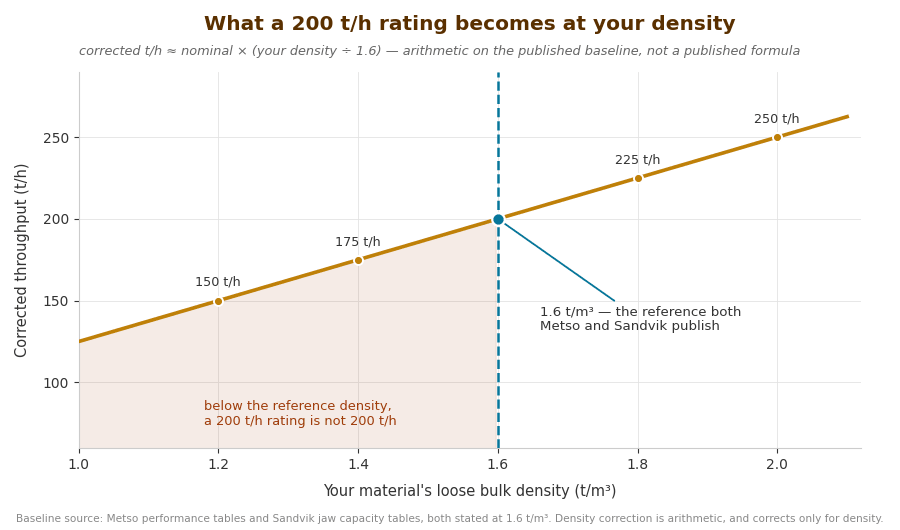
A 200 t/h rating corrected for loose bulk density against the 1.6 t/m³ reference both manufacturers publish. The correction is arithmetic, not a published formula.
Steps 3 and 4 are questions for the seller, and the answers belong in writing before an order, because they are the two that change what the number means rather than merely how accurate it is.
Which machine type is right for your rock in the first place is a separate question, worked through in jaw vs cone vs impact crusher, chosen by measured rock properties. The wear cost of running a chamber outside these conditions is in crusher wear parts and what actually drives liner life. On a second-hand plant these same conditions are readable from the machine itself, because the wear parts record how the last owner fed it, and that is covered in inspecting a used mobile crushing plant.
Plants currently in stock are listed under stone crushers, including the S10H mobile screener and the C3H mobile cone crusher.
Frequently asked
What density do published crusher capacities assume? 1.6 t/m³, or 1,600 kg/m³. Metso states it for its performance tables and Sandvik states it for its jaw capacity tables, adding that the reference material is clean, friable, dry granite with a solid density of 2.65 g/cm³.
Why is my crusher not reaching its rated tonnage? Metso publishes twelve conditions that reduce a quoted capacity. The three that catch most sites are sticky material in the feed, excessive humidity, and fines below 5 mm exceeding 10% of the crusher’s capacity. None of them is a fault in the machine.
Does opening the closed side setting increase capacity? Yes, and the manufacturer publishes by how much. On Sandvik’s CJ409, moving from a 50 mm to a 125 mm setting takes the published capacity from 85-115 mtph to 150-235 mtph, at the cost of a coarser product.
Should I fit a bigger motor to get more tonnes out of hard rock? Sandvik advises against it in unusually direct language, saying oversized motors “will lead to radically shorter crusher life and various mechanical problems” and that the warranty will not cover it. Its own recommendation for harder material is to open the setting instead.
Is a quoted t/h figure open circuit or closed circuit? Neither Metso nor Sandvik states it in the capacity notes we examined. Ask the supplier in writing, because in a closed circuit part of the crusher’s throughput is recirculated material rather than new product.
Sources, and what is missing from them
Every capacity condition, definition and figure on this page is quoted from a manufacturer handbook or technical specification, and linked where the claim is made. Two manufacturers are used, Metso and Sandvik, which is a narrow base and is stated here rather than disguised.
Two things are deliberately absent. There is no general correction formula, because no manufacturer publishes one; the density correction above is arithmetic on their stated basis and is labelled as such. And there is no circulating-load percentage, because nothing we could reach traces to a manufacturer or a paper.