Used Mobile Crushing Plant Inspection: What Checklists Miss
Release time: 2026-09-11
Published 14 September 2026. Reviewed by the HCQ Machinery crushing and screening team, Hefei, China, before publication.
Read the used-crusher inspection checklists currently in circulation and you will find cold-start behaviour, fluid levels, hose condition, exhaust colour, gauge function, and a reminder to confirm clear title. Every one of those items is correct. Every one of them would read identically for a tipper truck.
The parts that decide what a used crushing plant costs you in its first six months are the parts that only exist on a crusher, and they are almost entirely absent from that consensus. This page covers those, using the manufacturers’ own service manuals and application guides, and it is explicit about the several places where the industry repeats a claim that no manufacturer publishes.
The short answer. Four things carry most of the risk on a used plant, and none is on the standard checklist: how far the wear parts have already been consumed, whether the crusher’s protection systems still work, what the wear pattern says about how the machine was run, and whether the engine’s emission tier lets you import it at all. Ask for photographs of the wear parts before you ask about the engine.
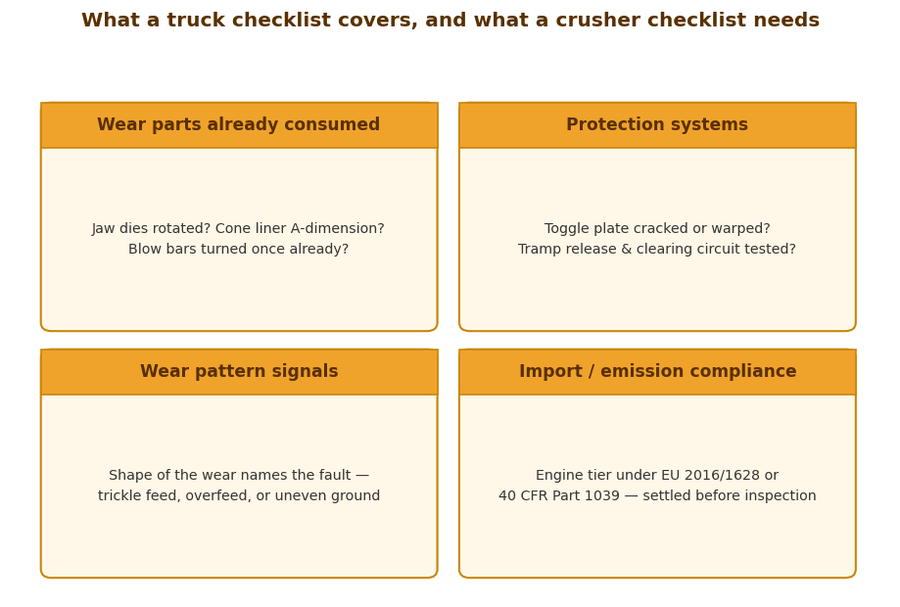
What a standard used-equipment checklist misses on a crushing plant.
Start with the wear parts, because they are the first invoice
A used plant with worn-out liners is a plant with an immediate parts order attached. Both manufacturers publish the change points, so this is checkable rather than negotiable.
Jaw dies. Metso: “rotate the single-piece jaw dies when 30% of the tooth profile is worn,” and “rotate a second time when the tooth profile at the bottom of the jaw die is completely worn.” (Metso, C Series jaw crusher wear parts handbook, doc. 3795-10-18, 2018. Accessed 10 September 2026.)
The question to ask is therefore not “are the dies worn” but “have they been rotated, and how many times.” A set already turned twice is a set at the end of its life, and the seller may not volunteer it because from the operator’s seat the machine still runs.
Cone liners. Metso states that liners “must be changed before they are worn through” and gives a change point at an “A dimension” that is model-specific, with 10-15 mm being the range across models rather than a figure for any one of them. So this is a question rather than an acceptance test: ask for the A dimension measured on this machine, and ask for the manufacturer’s figure for that model to measure it against. (Metso GP series wear parts application guide, document 2601-08-23-EN-CNS. Cited by Metso document number: the guide is distributed through Metso’s sales channels and we could not retrieve a stable public URL for it, unlike the C Series and NP Series guides linked elsewhere on this page.)
Blow bars. Metso: “Blow bars are reversible. When one face is used, the blow bar can be turned around to use the other face. This procedure can only be done once.” And: “Blow bars should be replaced before they are worn through. The wear limit ‘D’ is shown in the illustration,” which Metso gives as 50-80 mm depending on crusher size. So the same question applies: turned or not.
The wear-part alloys, the change points and what they cost to replace are set out in crusher wear parts and what actually drives liner life.
Read the wear shape before you read the hour meter
Wear parts record how the machine was operated, which is information the seller cannot edit. Terex publishes a diagnostic that reads each blow bar wear shape back to a specific operating fault, and Metso publishes the compressive-crusher equivalent in shorter form: “An uneven wear profile will decrease capacity, increase wear, and increase crushing forces,” and “incorrect feeding or feed gradation can lead to distorted wear profiles.”
The six wear shapes and what each one indicates are set out in full in crusher wear parts and what actually drives liner life, and they are worth having open while you look at the photographs. For an inspection, the three that change a purchase decision are these. Wear concentrated at the centre indicates a trickle feed, so the plant was starved. Wear at both ends indicates a high proportion of fines or overfeeding. Wear on one side only indicates a machine run out of level, run without choke feeding, or fed onto one side of the feeder.
None of those is a fault in the machine, and all three leave consequences beyond the liner: a plant run out of level for a year has loaded its bearings unevenly for a year. Ask for close-up photographs across the full width of the wear parts before anything else.
The jaw plant parts nobody’s checklist mentions
The toggle plate. Sandvik’s own operator’s and maintenance manual carries dedicated tasks for it: “doing a visual inspection of the toggle plate for cracks, warping or damage,” a check of “the toggle plate hydraulic cylinders for damage, wear or dirt,” and a separate procedure for “replacing or removing the toggle plate.” (Sandvik QJ341+ Stage V operator’s and maintenance manual, 2 August 2023, §§11.7.44, 11.7.45, 11.8.28.) Metso lists the toggle plate as a wear part and describes its protective role: its automatic setting control “also includes a toggle plate for optimum jaw crusher protection.” (Metso C Series brochure, doc. 4226-04-24-EN-AGG, 2024.)
A cracked or warped toggle plate is a cheap part and an expensive signal, because warping means the machine has taken loads it was not meant to take.
The pitman bearings. Metso: “The four large and identical spherical roller bearings are labyrinth sealed.” It also describes two protective features worth checking exist and are intact: “pitman eye protection protects the bearings and the pitman casting from impacts caused by really coarse feed, and it is also effortless to change,” and “the unique three cylinder concept prevents the pitman bearings from twisting.”
The CSS adjustment mechanism. This determines what the plant can be set to do and how quickly. Metso: “The setting can be adjusted with two wedges without shim plates. Adjustments are mechanical as standard. A fully automatic hydraulic option is also available to make adjustments even faster and safer.” Establish which one the used machine has, and whether the hydraulic version still functions, because a seized adjustment is a plant locked at one product size.
The cone plant parts nobody’s checklist mentions
A cone’s protection systems are what stand between an uncrushable object and a broken machine, and on a used plant they are the things most likely to have been bypassed.
Metso, on tramp release: “Dual acting hydraulic tram release cylinders protect the crusher against overloading and for example let the tramp iron pass through the crusher,” and “the double-acting tramp-release cylinders linked with the accumulators make the tramp-release system extremely reactive and ensure instant recovery.”
Metso, on the clearing circuit: “The large clearing stroke allows uncrushable objects to pass through the crusher cavity,” and “the large clearing stroke, together with the double-acting hydraulic hold-down cylinders, ensures quick, easy and safe clearing of the cavity in case the crusher stops under load.” (Metso HP Series brochure, doc. 4236-10-22-EN-AGG, 2022.)
Ask for both to be demonstrated, and ask for the accumulator pre-charge to have been checked. A tramp release system with flat accumulators is present on the machine and absent in function.
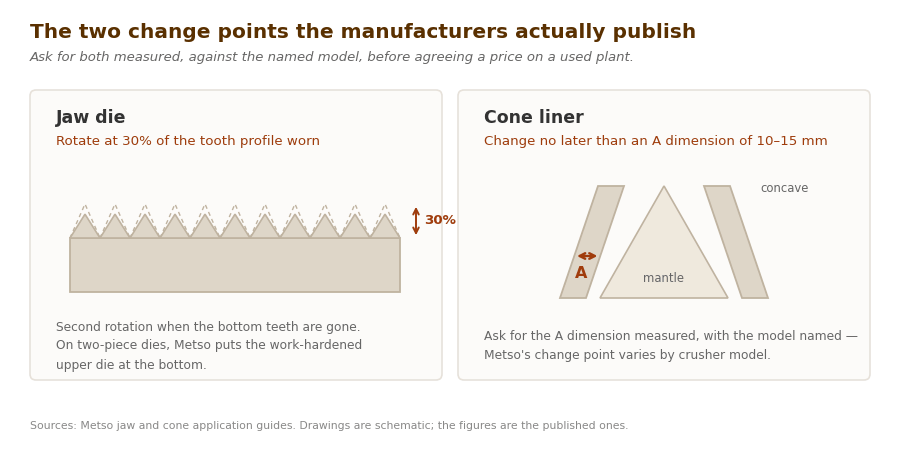
The two change points the manufacturers actually publish. Sources: Metso jaw and cone application guides.
Screen media, where the wear indicators are published
Sandvik publishes what to look for, and it is more specific than “check the screens.”
| Indicator | Sandvik’s wording |
|---|---|
| Holes | “If holes have formed in the mesh or modular panels, this is often visible to the naked eye” |
| Thinning | “bridges between holes are thinning and taking on a concave shape” |
| Capping | “The capping should be monitored as regularly as possible” |
| Feed box and discharge | “The liners on the feed box and discharge lip should also be checked regularly for wear” |
| Fixing | Check “the screening media touches the capping rubber on all of the support bars”; on centre hold-down bars, “important to regularly check their bolts to make sure they are properly tensioned” |
| Failure | Media that has “blown-out” should be “replaced immediately” |
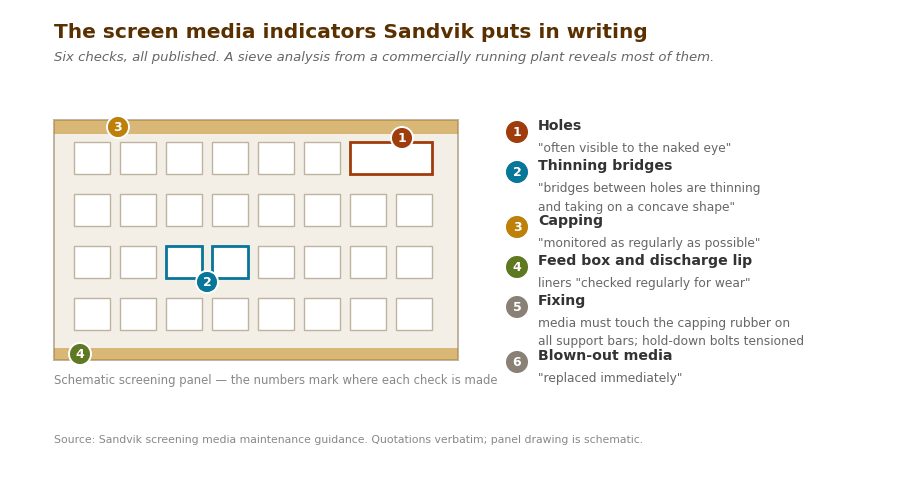
Sandvik’s published screen media wear indicators. Source: Sandvik screening media maintenance guidance.
Source: Sandvik Rock Processing, screening media maintenance and replacement. Accessed 10 September 2026.
Sandvik also notes the non-visual check worth asking for: “regular sieve analyses or other quality control measures can give insight into the condition of screening media.” If the seller has been running the plant commercially, gradation results exist.
Four things the industry says that no manufacturer publishes
This section exists because these claims appear constantly in dealer and marketplace content, and we could not source any of them. They are not necessarily false. They are unsupported, and a buyer should treat them accordingly.
“A tracked crusher has two hour meters, engine hours and crushing hours, and the ratio tells you how it was used.” The reproducible half of this is Sandvik’s QJ341+ operator’s and maintenance manual, linked below, whose service schedule expresses every interval simply as “every 10 hours / 50 / 250 / 500 / 1000 / 2000 hours” and uses none of the terms “hour meter,” “hour counter,” “engine hours” or “crushing hours.” We also searched published Kleemann, Metso Lokotrack and Powerscreen material without finding the distinction, but those searches covered public marketing and specification pages rather than operator’s manuals, so treat the Sandvik finding as the evidenced one. Do not treat the ratio as a fact. Do ask the question as an inspection instruction: ask what hour figures the machine records and photograph each display, because if the plant does record more than one, the difference is informative even though no manufacturer says so.
“The toggle plate is designed to shear and act as a sacrificial fuse.” Manufacturers describe the toggle plate as protective and list it as a wear part, and Sandvik publishes inspection and replacement procedures for it. Neither describes it as designed to break on an uncrushable. Inspect it for cracks and warping, which is what the manual actually says to do.
“Undercarriage is worn out at X% of new dimension.” We found no crushing-plant manufacturer publishing undercarriage wear limits at all. The guidance that does exist publicly comes from earthmoving manufacturers and is written for dozers and excavators, and Caterpillar’s public page on track pins and bushings, while manufacturer-hosted, gives figures we could not reconcile with the measurement it describes and are therefore not reproducing. What is sourceable and useful from that page is the principle rather than the number: pins and bushings can often be turned once to expose a fresh wear surface rather than replaced. Treat the undercarriage as a separate item to be measured by a component specialist and priced separately from the plant.
“Bushing cones are lower maintenance than roller-bearing cones,” or the reverse. We could find no manufacturer document comparing the two designs on maintenance, tramp handling or life. Terex MPS’s own article on choosing a cone compares bowl and shaft styles and says of the bronze-bushed design only that it offers “the ability to change the eccentric throw of the cone easily and economically.” Whatever a seller tells you about this, ask which document it comes from.
One more we could not close: no manufacturer publishes what a cone that has been run without choke feeding looks like on inspection. Metso states the requirement and states that “a distorted wear profile may decrease capacity, increase the liner wear rate and increase the crushing force,” but stops short of describing the visual signature. Judge the wear profile as distorted or even, and leave the diagnosis there.
The engine decides whether you can import it
This is the part of the purchase that is settled before the machine is inspected, and getting it wrong is not a repair bill but a stranded container.
A tracked mobile crushing plant is non-road mobile machinery. Regulation (EU) 2016/1628 applies to “engines falling within the categories set out in Article 4(1) which are installed in or are intended to be installed in non-road mobile machinery,” and Article 3(1) defines that as “any mobile machine, transportable equipment or vehicle with or without bodywork or wheels, not intended for the transport of passengers or goods on roads.” The regulation never names crushers or screens; the applicability comes from that generic definition. Engines of this kind sit in the NRE category on the face of the Article 4(1) list, but the regulation does not say so for crushing plant specifically, so confirm the category with a broker rather than assuming it.
The hinge is Article 2(2), which excludes stationary machinery. A tracked or wheeled plant is in scope. A permanently installed plant is not. That distinction, rather than the category list, is what decides a given machine, and it is worth settling in writing before purchase.
In the United States the parallel is 40 CFR Part 1039, which applies “for all new, compression-ignition nonroad engines” with model-year applicability by power band. What that means for a specific destination, including pre-shipment conformity certificates and used-goods duty, depends on the destination country’s own rules, so confirm the specifics with a customs broker before shipping.
One thing we could not resolve: how a dual-engine or generator-set plant is treated. The regulation’s NRG category is defined by both exclusive generating-set use and a rating above 560 kW, so a genset engine below that threshold does not fall in NRG, and no manufacturer or regulator source we found addresses the dual-engine mobile plant case. If the machine you are looking at has a separate genset, put the question to a broker before you commit.
What to ask for before a deposit
| Ask | What it settles |
|---|---|
| Photographs of the jaw dies, and how many times they have been rotated | Whether the wear parts have life left or are an immediate order |
| The cone liner “A dimension”, measured, with the model named | Metso’s published change point is 10-15 mm depending on model |
| Whether the blow bars have been turned | They can be reversed once, and only once |
| Close-up photographs of the wear profile across the full width | The shape names the operating fault, per the Terex diagnostic set out in the wear parts article |
| A photograph of the toggle plate | Cracks or warping indicate loads the machine was not designed for |
| A demonstration of the tramp release and the clearing circuit, and when the accumulators were last checked | These are the protection systems, and they fail silently |
| Which CSS adjustment the machine has, mechanical or hydraulic, and whether it still moves | A seized adjustment locks the plant at one product size |
| Photographs of every hour display on the machine | No manufacturer documents a two-meter convention; record what the machine actually shows |
| The engine make, model, serial number and emission tier, from the nameplate | Decides admissibility before anything else matters |
| Recent gradation results, if the plant has been running commercially | Sandvik notes sieve analyses reveal screen media condition |
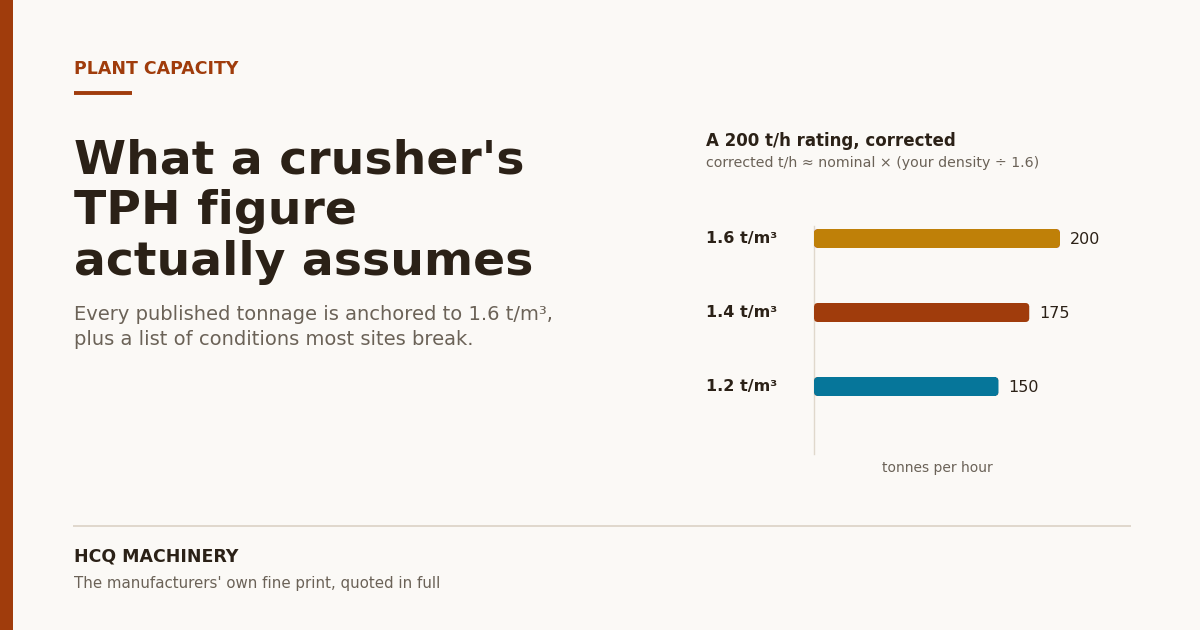
Whether the machine suits your rock at all is a separate question and should be settled first, in jaw vs cone vs impact crusher. What it will actually produce once installed is in what a crusher’s TPH figure actually assumes.
Used and new plants currently in stock are listed under stone crushers, including the Komatsu BR1000JG crawler jaw crusher.
Three questions worth settling first
What should I check first on a used mobile crusher?
The wear parts, before the engine. Their remaining life is the first invoice after purchase, and their wear shape is the only record of how the machine was operated that the seller cannot revise.
Do tracked crushers really have separate engine hours and crushing hours?
No manufacturer document we could find says so, including Sandvik’s own operator’s manual, which expresses all service intervals as a single hour figure. Ask what the machine displays and photograph it rather than relying on a ratio the industry repeats but nobody publishes.
How do I know if the cone liners are finished?
Metso publishes the criterion: liners must be changed before they wear through, and “no later than when the A dimension is 10-15 mm depending on crusher model.” Ask for it measured against the specific model.
Can a used crushing plant be imported into the EU?
Its engine has to satisfy Regulation (EU) 2016/1628, which reaches it through the general definition of non-road mobile machinery rather than by naming crushers. The decisive question for a given machine is Article 2(2)’s exclusion of stationary machinery: a tracked or wheeled plant is in scope, a permanently installed one is not.
How this page was put together
Every inspection point, change dimension and protective-system description here is quoted from a manufacturer’s own service manual, application guide or brochure, and linked where the claim is made. The emission provisions are quoted from the regulation itself and from the eCFR rather than from any commentary on them.
The section on unsourced industry claims is the part worth understanding. Those four claims are marked as not sourced, which is not the same as false. Each may well be true. What we can say is what we searched and what we did not find, and each entry says so.