


Parts of an Excavator: Names, Functions and What to Check
Release time: 2026-11-19
What are the parts of an excavator called, and what does each one do? The diagram below labels 15 parts, each with its English and Spanish name. They form three groups: the work equipment digs, the upper structure powers and turns the machine, and the undercarriage carries and moves it. For every part you get its job and the check that matters on a used machine.
Terminology for hydraulic excavators is set out in the international standard ISO 7135. Manufacturers print the everyday names in their specification sheets and parts catalogues, and those are the names used here.
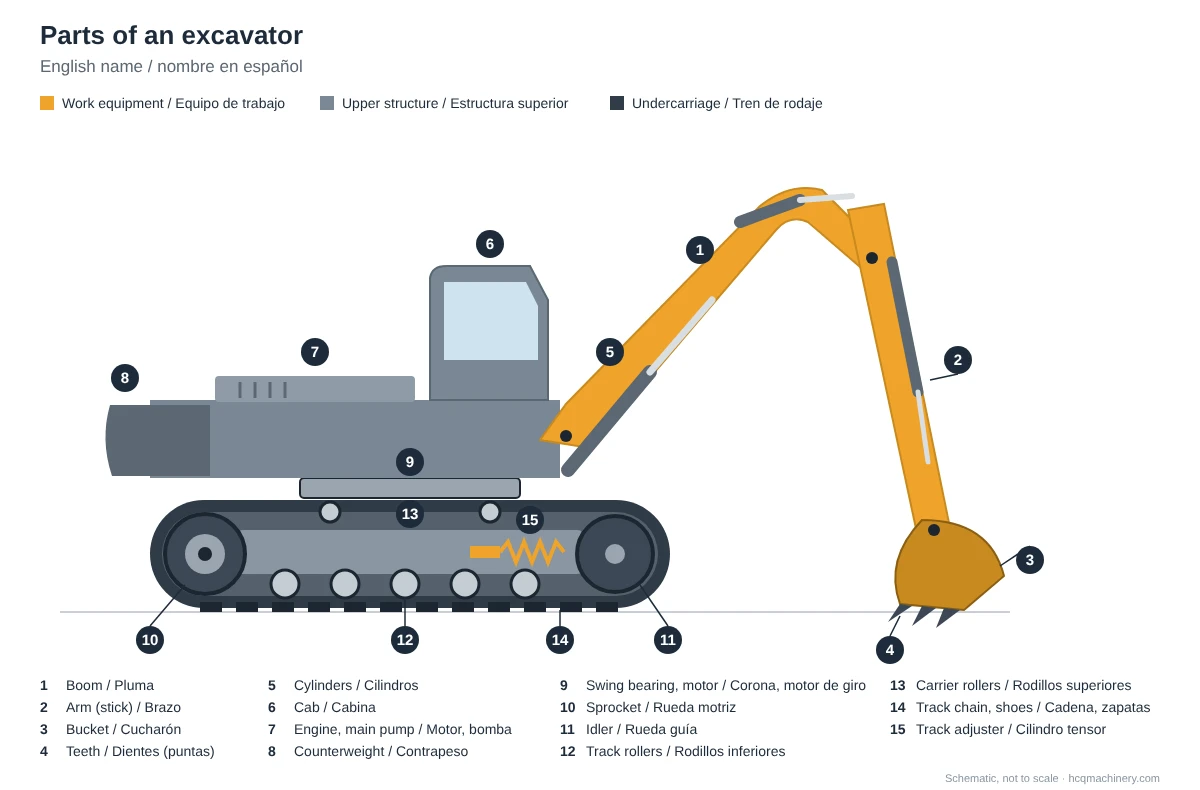
The main parts of an excavator at a glance
The table lists the main parts of an excavator in the order of the diagram. It is the short version of the parts of an excavator and their functions. The Spanish column gives the name printed in Spanish-language manufacturer and parts literature, with a second name where one is also common. If you are pricing used excavators, the last column is the one to use.
| # | Part | Spanish name | What it does | What to check on a used machine |
|---|---|---|---|---|
| 1 | Boom | Pluma | Main lifting member, from the upper structure to the arm | Cracks or fresh welds near the boom foot and cylinder mounts |
| 2 | Arm (stick) | Brazo | Second member; sets reach and digging force at the bucket | Cracks near the nose pin; play at the boom-to-arm pin |
| 3 | Bucket | Cucharón (balde) | Digs, carries and dumps material | Worn lip and side plates; cracks around the hinge |
| 4 | Teeth and adapters | Dientes; puntas y adaptadores | Replaceable points that cut into the ground | Tips worn to the adapter; missing retaining pins |
| 5 | Hydraulic cylinders | Cilindros hidráulicos | Move the boom, arm and bucket | Oil on the rod, scored chrome, a boom that settles when held |
| 6 | Cab and controls | Cabina; palancas de mando | Operator station with joysticks, travel levers and pedals | Fault codes on the monitor; pedal and joystick wear against the hours shown |
| 7 | Engine and main pump | Motor; bomba hidráulica principal | The engine drives the pump, and the pump feeds oil to every function | A cold start, exhaust smoke, and slow functions under load |
| 8 | Counterweight | Contrapeso | Balances the load at the bucket | Cracks and loose or missing mounting bolts |
| 9 | Swing bearing and swing motor | Corona de giro; motor de giro (mando de giro) | Let the upper structure turn on the undercarriage | A clunk when a swing stops; oil around the motor |
| 10 | Sprocket and final drive | Rueda motriz; mando final | The final drive turns the sprocket, which pulls the track chain | Hooked or sharp teeth; oil on the final drive housing |
| 11 | Idler | Rueda guía | Guides the chain at the front and moves to set tension | Worn tread; wobble when the track turns |
| 12 | Track rollers | Rodillos inferiores | Carry the machine’s weight on the chain | Flat spots, seized rollers, leaking seals |
| 13 | Carrier rollers | Rodillos superiores | Hold up the top run of the chain | Worn bearings; rollers that sag or do not turn |
| 14 | Track chain and shoes | Cadena (oruga); zapatas | Links joined by pins and bushings, with bolted shoes | Pin and bushing wear; bent shoes; different link counts left and right |
| 15 | Track adjuster | Cilindro tensor | Grease cylinder and recoil spring that hold chain tension | Grease leaks; tension that will not hold |
Spanish names come from Caterpillar’s Spanish specification sheet and parts pages, the Wirtgen Group undercarriage brochure and a Mexican parts catalogue. Others are the terms that appear in Google searches in Mexico (sources at the end).
Work equipment: boom, arm, bucket and cylinders
The work equipment is the front end of the machine: boom, arm, bucket and the cylinders that move them. It does the digging, so it takes the shock loads. On a used machine, the work equipment shows how hard the excavator has worked.
The boom (pluma) rises from the upper structure. The arm (brazo) hangs from the boom nose. English speakers also call the arm the stick or the dipper, and all three words name the same part. The bucket (cucharón) pins to the end of the arm. Hydraulic cylinders move all three. The boom is lifted by one or two cylinders, depending on machine size, and the arm and bucket have one cylinder each.
Every joint turns on a pin inside a bushing (pasadores y bujes). Pins and bushings are cheap wear parts. If they are left too long, the bores they sit in can wear oval, and the repair then needs line boring and welding.
To check the work equipment on a used excavator:
- Lift the bucket off the ground and watch each joint while the operator rocks the bucket. Visible movement means worn pins or bushings.
- Look at the welds near the boom foot, the cylinder mounts and the arm nose. Fresh paint on a single area deserves a closer photo.
- Hold the boom up with the engine running and watch it for a few minutes. A boom that settles points to a cylinder seal or valve problem.
What are the bucket teeth called?
The everyday name is bucket teeth (dientes). On a parts list, a tooth is two pieces. The tip (punta) is the part that wears and gets replaced. The adapter (adaptador) is welded or bolted to the bucket lip and holds the tip. Caterpillar’s Mexican catalogue lists tips and adapters together with side cutters (cortadores laterales) and the base edge (borde de base).
Order tips by the adapter system on the bucket, not by the machine model. Two buckets on the same model can carry different systems.
Upper structure: cab, engine, pump, swing and counterweight
The upper structure is everything above the swing bearing: cab, engine, hydraulic pump, control valve, swing motor and counterweight. The whole assembly turns as one unit on the undercarriage.
The engine drives the main hydraulic pump (bomba hidráulica principal). The pump sends oil to the main control valve (válvula de control principal), and the operator’s joysticks decide which cylinder or motor receives it. Caterpillar’s Spanish specification sheet for the Cat 336 is a useful reference. Its Spanish terms include corona de giro, mando de giro, mando final, contrapeso and válvula de control principal.
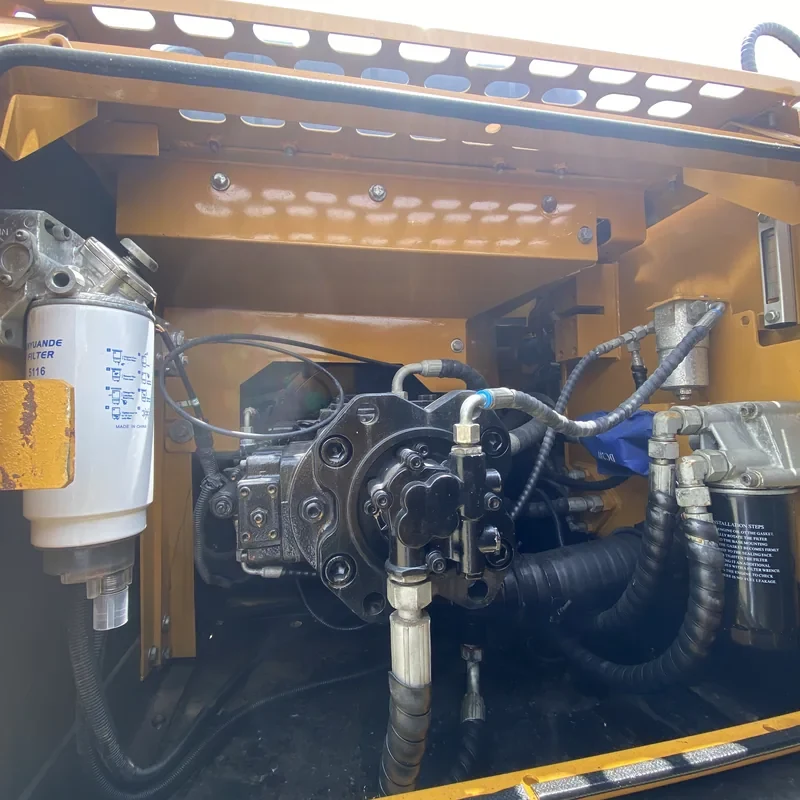
The swing motor (motor de giro) drives a pinion against the gear ring of the swing bearing (corona de giro). That is how the upper structure turns. The counterweight (contrapeso) at the rear balances the load at the bucket.
The owner of a China-built mini excavator, an AGT QK16R, saw a long trail of oil behind it the last time he used it. He suspected the slew motor, which is another name for the swing motor. On his machine the motor is held by four M8 cap bolts with lock washers. His understanding was that loose bolts let the motor move and tear its O-ring. In late October 2025 he opened it up. Even reaching the motor meant removing the floor plate, a foot pedal and a canopy support.
We advise starting with the swing motor area when you inspect the upper structure of a used machine. Ask for a close photo of the motor and its mounting bolts, and a slow full swing in both directions on video. A wet motor base, a clunk as the swing stops, or a jerk on starting are reasons to look closer. Our guide to swing motor leak signs shows where to point the camera.
What are the controls of an excavator called?
The controls of an excavator are two joysticks, two travel levers with foot pedals, and a hydraulic lock lever. In Spanish the joysticks are palancas de mando. In the most common pattern, the left joystick swings the upper structure and moves the arm. The right one raises the boom and curls the bucket. Control patterns differ between brands and can be switched on many machines, so check which pattern a used excavator is set to before the first test.
Excavator undercarriage parts
The excavator undercarriage parts are the sprocket, idler, track rollers, carrier rollers, track chain, shoes and track adjuster, plus the final drive that turns the sprocket. In Spanish the whole assembly is the tren de rodaje.
The undercarriage matters to a buyer because it is expensive to keep. Caterpillar Mexico states that the undercarriage can represent up to 50% of a machine’s repair and maintenance costs.
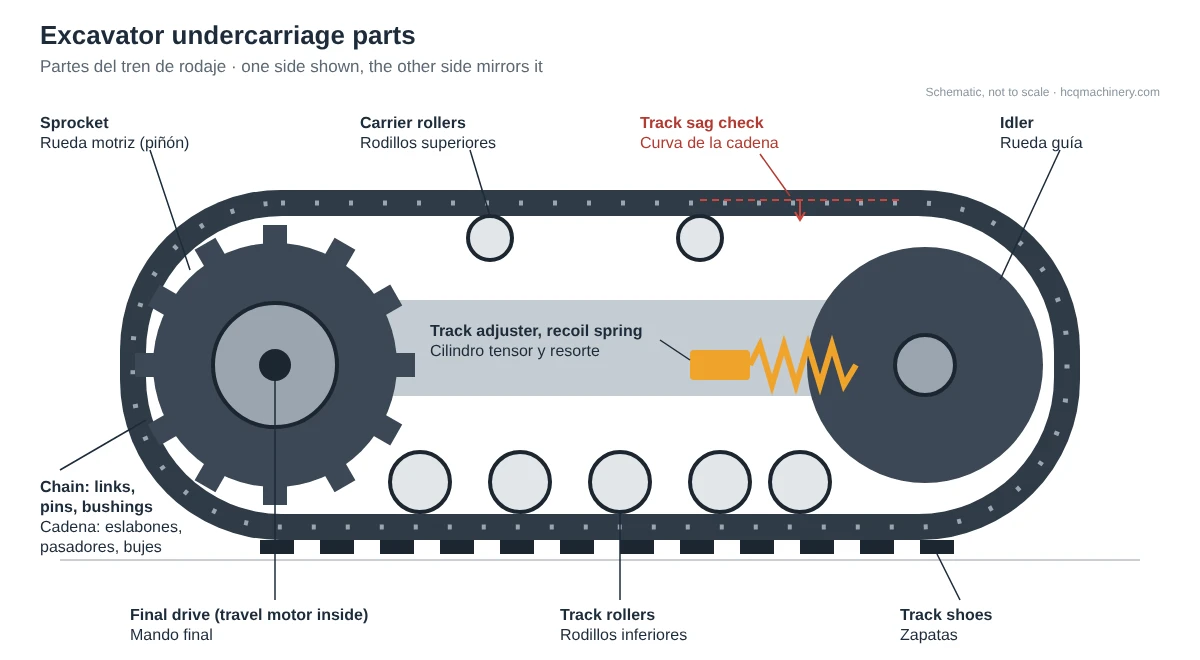
| Part | Spanish names you may see | Where it sits |
|---|---|---|
| Sprocket | Rueda motriz, rueda de accionamiento, piñón de impulsión | Rear of the track, on the final drive |
| Final drive | Mando final, unidad de accionamiento | Inside the sprocket hub |
| Idler | Rueda guía, rueda direccional | Front of the track |
| Track rollers | Rodillos inferiores, roldanas, rodillos portantes | Under the track frame |
| Carrier rollers | Rodillos superiores, rodillo portador | On top of the track frame |
| Track chain | Cadena, cadena de oruga | Around the whole assembly |
| Track shoes | Zapatas | Bolted to the chain links |
| Track adjuster | Cilindro tensor | Behind the idler |
Names from the Wirtgen Group undercarriage brochure (Spanish edition), Caterpillar’s Spanish literature and a Mexican undercarriage parts catalogue.
A 2006 Cat 320CL with about 7,000 hours was bought in November 2022 to dredge a 20-acre pond. In early 2023 its sprockets were worn sharp. One bottom roller had frozen and worn a flat spot, and a second had seized. A free undercarriage inspection by the Cat dealer produced a detailed wear report and a list of what to replace. The owner set out to replace the sprockets, four carrier rollers and three bottom rollers, and to rebuild the track adjusters. He bought a new chain, and the dealer moved the old shoes onto it. While pressure washing the adjusters, the owner found the large tensioner spring broken near one end.
We read that list as a parts map. Each line names a separate part with its own price, and all of them appear in the table above. We advise asking for the same items on any used machine: close photos of both sprockets, every bottom roller and every carrier roller. Then ask for a clip of the machine tracking in a straight line. Our guide to undercarriage wear signs shows how worn parts compare with the hours on the meter.
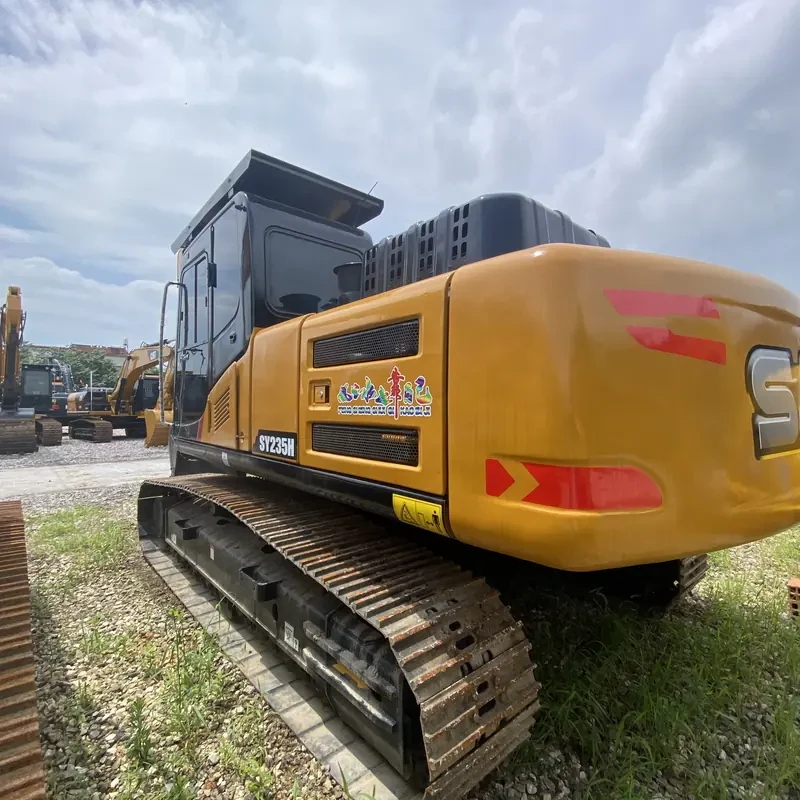
On another tracked machine, the owner fitted new tracks that were slightly longer, so the adjuster sat 5 inches further out. Since then, the tracks had been coming off the sprockets often. A mechanic pointed to two causes: the tracks were too tight, and the upper roller bearings were worn out. The carrier rollers sagged about 2 degrees on both sides, and in the mechanic’s view that was guiding the tracks off.
We recommend treating carrier rollers as their own line on any undercarriage quote, separate from the bottom rollers. Check the track sag against the operator’s manual for that model. Caterpillar Mexico recommends a sag of 4.5 to 6.5 cm and notes that the figure depends on the model.
The final drive (mando final) sits inside the sprocket hub and contains the travel motor and its reduction gears. Oil on the final drive housing or a grinding noise when the machine travels is a costly sign. Our final drive checks cover what to film and what to listen for.
Using these part names when you buy or order
Part names save time only when they come with the machine’s identity: model, serial number and position on the machine. A parts seller needs to know which machine, which side and which position before the name means anything.
Send these six details when you ask a supplier for a part, a photo or a price:
- The model and serial number, with a photo of the serial plate.
- The part name in English, and the part number if you have the parts book.
- The side and position, such as “left track, third bottom roller from the sprocket”.
- A photo of the old part next to a tape measure.
- For hydraulic parts, the port and thread sizes and the bolt spacing.
- The quantity, and whether you need a pair.
The same list works when you buy a used machine from abroad. Name the parts you want to see, and ask for each one by its English name. For any machine you enquire about, we send photos of its serial plate and hour meter. On request we film a walk-around, a cold start, or a close-up of any part you name. You can also come to our yard in Hefei and inspect a machine in person. We also supply spare parts, so the same six details work for a parts enquiry to us.
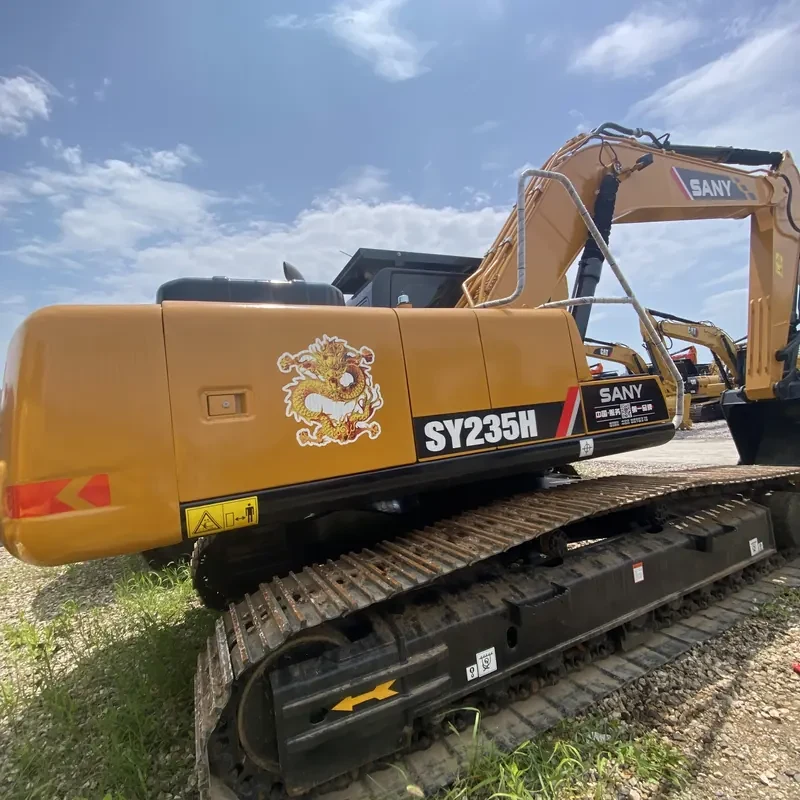
HCQ Machinery (Anhui Huachunqiang Machinery Equipment Co., Ltd.) exports used construction machinery from Hefei, China (company facts). The Sany SY235H in the photos above has its own product page with photos and specifications.
Common questions about excavator parts
What are the 10 basic hydraulic components of an excavator?
On an excavator they are these ten: tank, main pump, main control valve, cylinders, swing motor, travel motors, centre swivel joint, hoses, filters and oil cooler. The cylinders are the boom, arm and bucket cylinders. The centre swivel joint carries oil from the upper structure down to the travel motors while the upper structure swings.
How many types of backhoe are there?
Backhoe loaders come in two main designs: side-shift and centre pivot. On a side-shift machine the boom slides along rails at the rear, while a centre pivot boom swings from one fixed point.
Which parts of an excavator cost the most to repair?
Start with the undercarriage: Caterpillar Mexico says it can represent up to 50% of a machine’s repair and maintenance costs. The engine, the main hydraulic pump and the final drives are other large repair items to price before you buy.
Is the arm the same as the stick?
Yes. Arm, stick and dipper are three English names for the same part between the boom and the bucket. In Spanish it is the brazo.
One Spanish naming trap
Two Spanish excavator parts names look almost the same and point to different rollers. The Wirtgen Group brochure uses rodillos portantes for the rollers that carry the machine’s weight, which are the bottom track rollers. The Mexican parts catalogue uses rodillo portador for the top carrier roller. Add superior or inferior (top or bottom) to the name every time you order a part or ask for a photo. To see close-ups of a machine in our listings, tell us which one and the parts you want filmed.
Prepared by HCQ Machinery’s export team · Last updated: 18 November 2026
Sources
- ISO 7135 (2009 edition), Earth-moving machinery, hydraulic excavators, terminology and commercial specifications (iso.org, linked above)
- Caterpillar Mexico, undercarriage maintenance tips, August 2026 (cat.com, linked above)
- Caterpillar Mexico, ground engaging tools for excavators (cat.com, linked above)
- Caterpillar, Cat 336 hydraulic excavator specification sheet, Spanish edition, hosted by Ferreyros (linked above)
- Wirtgen Group, Parts and More Compact, undercarriage components, Spanish edition, 12/2018 (linked above)
- Friday Parts Mexico, undercarriage parts catalogue for the Komatsu PC200-5 (linked above)
- Caterpillar, side-shift or center pivot backhoes, September 2026 (cat.com, linked above)
How this page was made: drafted with AI assistance and checked on 18 November 2026 against the sources listed above. The two diagrams were drawn in code for this page; the photographs come from our own listing of a used Sany SY235H.

