Grey Market Excavator: What It Means for Parts, Serial Numbers and Dealer Support
Release time: 2026-10-21
A grey market excavator is a machine built for one country’s market, usually Japan, and later sold in another country outside the brand’s own distribution. The machine is genuine; what changes is support. Several makers state in writing that their local dealers will not provide warranty, and some say they will not supply parts or manuals, for grey market machines in North America or Australia. We found no maker statement for other regions, so do not assume support there either: check whether your local dealer’s system recognises the serial number and whether the parts you need share numbers with the local model.
“My serial number won’t even show on a U.S. parts computer,” wrote a US owner of a Kobelco bought from China on r/heavyequipment (30 March 2025); he added that “some dealers won’t even sell me parts.” Another owner, of grey market Hitachi and Komatsu excavators, reported the opposite: “Local parts still fit and easily available from dealerships” (r/heavyequipment, 3 June 2024). Owner reports vary; the makers’ written positions are in the table below. This guide shows what the makers say, what differs on the machine, and what to check before you pay.
We sell used excavators, including machines that worked in Japan, so we have an interest here. We have kept to what the makers publish and to what you can check yourself.
What the makers say
These are the official notices we found. Each covers one region; none of them covers Africa, Latin America, the Middle East or Southeast Asia.
| Maker (region) | What the notice says | Source |
|---|---|---|
| Kobelco (North America) | Kobelco Construction Machinery USA “does not support Gray Market Products” imported by third parties, lists technical and repair information, manuals and specifications, warranty, and “spare parts or parts technical information” as support it does not provide, and warns that “the safety and emissions standards for North America may not be met” | Kobelco USA notice |
| Yanmar (United States) | “Yanmar does not support gray market Yanmar-brand tractors, excavators, wheel loaders and carriers and will not knowingly supply replacement parts for gray market units”; “There is also no warranty from Yanmar for these used units” | Yanmar America notice |
| DEVELON, formerly Doosan (North America) | “Neither DEVELON nor any of its authorized dealers have any warranty services or obligations to these Gray Market machines,” which “may have varied parts and specifications that can be difficult to replace or repair; costing the customer much more in dollars, downtime and aggravation” | DEVELON North America notice |
| HD Hyundai (North America) | Hyundai North America and its dealers “cannot provide any warranty for these machines”; the notice adds that grey market machines “do not meet the U.S. EPA requirements to be sold as new in North America”, and that “Parts and service for Grey Market machines is frequently complicated” | HD Hyundai North America advisory |
| Kubota (Australia) | Kubota Australia and Kubota Corporation do not provide “parts, service, technical data or any warranty support” for grey market units in Australia | Kubota Australia notice |
We did not find a published grey market notice from Caterpillar, Komatsu, Hitachi, John Deere or Takeuchi for construction machines, so we cannot tell you their position. Kubota USA’s notice covers tractors only, so we have not listed it for excavators.
DEVELON’s notice adds: “don’t be fooled just because the model number is the same or it comes with an English manual.” A Japan-market machine can carry the same model name as the local one and still differ in parts.
What actually differs on a Japan-market machine
The makers’ notices and owners’ reports point to four areas:
- Serial numbers. The local dealer’s parts system may not recognise a serial number from another market, which is the complaint quoted at the top. The next section shows what the makers’ own documents say about serial ranges.
- Part numbers. Owners describe some parts as common and some as different. One wrote that “parts commonality is and isn’t a problem” (r/heavyequipment, 19 July 2020). Which parts differ depends on the model, and the only reliable check is by part number.
- Manuals and labels. Kobelco’s notice warns of “manuals and safety labels that may not be in English.” The same owner thread notes that US dealers “technically have access to the parts manuals, but they’re all in Japanese” (r/heavyequipment, 19 July 2020).
- Keys and security. Some machines use coded keys. On Kubota’s system, for example, a commenter explained that “you need the red key to program the black key” and that “a new red key must be programmed by a dealer” (r/kubota, 9 June 2026), so a machine sold without its master key can be hard to re-key, and a grey market owner may not get a replacement master key from a local dealer.

A Komatsu PC200 in our yard, photographed for our library in March 2026. The Japanese company name, the fleet code “TPSO25-1763” and the Japanese air-conditioning sticker show where this machine worked. Decals like these are the first clue to a machine’s market; the serial plate is the proof.

A Caterpillar 320D2L in our yard, March 2026, still carrying its previous Japanese owner’s company decal on the engine panel. Next to the model badge is a “REGA” badge. One commenter in the Reddit thread quoted above links grey market Cats to “the REGA marked models made by Shin Caterpillar Mitsubishi”, Caterpillar’s former Japanese joint venture (r/heavyequipment, 19 July 2020). That is a commenter’s explanation, not a Caterpillar statement, and we have not confirmed where this machine was built; the badge is a quick first clue on a Cat; the serial plate is still the proof.
Serial numbers and labels: what the documents show
The makers publish serial ranges on their manuals, and the ranges differ for machines with the same model name:
| Maker and model | What the maker’s document says | Source |
|---|---|---|
| Komatsu PC200-8 | Shop manual SEN00084-20 covers “PC200-8 300001 and up”; SEN06109-03 covers “PC200-8M0 400001 and up”; a Brazil-printed manual (KEN00084-13, seen only on a reseller listing) covers PC200-8, PC200LC-8 and PC240LC-8 from “B30001 and up, B10001 and up” | Komatsu shop manual covers (SEN00084-20, SEN06109-03) |
| Kobelco SK200-8 | Serial “YN11-45001~” in the applicability table, whose remarks column names markets such as “(ASIA, OCE)” and “(North America)” | Kobelco shop manual S5YN0118E01 (applicability table) |
| Caterpillar (all models) | “The serial prefix is the first three characters in a Cat equipment’s serial number”, followed by a five-character sequence; the 320D parts guide lists the prefixes PHX and SPN | Cat Publications; Cat 320D parts reference guide |
We found no Komatsu or Caterpillar document that says which serial range or prefix belongs to which factory or market; the Kobelco table is the only one we found that names markets, in a remarks column. So a serial number does not tell you by itself whether a machine was built for Japan. What matters to you is whether your local dealer’s parts system recognises it, which is why the check below asks for it.
Newer machines may also carry a 17-character product identification number under ISO 10261: a three-character manufacturer code, a five-character machine descriptor, a check letter in position 9 and an eight-character machine identifier, stamped on the frame. Caterpillar, for example, says its machines began using a 17-character PIN in 2001, with the serial number as its last eight characters, and that most Cat machines built in 2001 and earlier carry only the 8-character number (Cat Publications).
Japan-market machines also carry Japanese labels:
- Off-Road Act label (基準適合表示). Japan’s Off-Road Act took effect on 1 April 2006. The Ministry of the Environment says a machine covered by the law cannot be used in Japan unless it carries the conformity label or a similar mark (基準適合表示等が付されたものでなければ国内で使用できません, MOE); there are label versions for the 2006, 2011 and 2014 standards (MOE label page). Machines built before the law took effect are exempt from that rule (MOE, 7 March 2005), so an older Japan-market machine may carry no Off-Road Act label at all.
- MLIT emission-controlled machine sticker (排出ガス対策型). Japan’s Ministry of Land, Infrastructure, Transport and Tourism has designated machines meeting its emission limits since the early 1990s, in three stages (MLIT), the third from 2006 (MLIT, 18 December 2023).
- Low-noise and ultra-low-noise marks (低騒音型 / 超低騒音型). Under a 1997 Ministry of Construction notice (the ministry is now part of MLIT), a designated machine may display these marks (表示することができる), so they are voluntary (MLIT). They certify noise, not emissions.
We found no statement from EPA, the EU or the Japanese ministries that any of these labels counts as EPA or EU certification. Some sellers state plainly that a machine is not certified: a 2013 Cat 320D listed from China on MachineryTrader on 30 September 2026 was marked “(NO EPA or CE, NOT for use in US and/or CANADA)” (listing). For what a US label must show, see our guide to Tier 3 vs Tier 4 used excavators.
Checks to make before you pay
- Get the serial plate and the engine plate photographed. Ask for clear, close photos of both, taken the same day, plus the build year.
- Call your local dealer with the serial number. Ask two questions: does it come up in their parts system, and will they sell you filters and seals for it? Their answer is worth more than any seller’s promise, including ours.
- Ask for the part numbers of the expensive items. For the travel motors, swing motor and main pump, the maker’s plate on the component gives a number you can check with a rebuilder. Our guides to final drive and travel motor checks and swing motor checks show where these parts sit.
- Check the monitor language and settings. Ask for a video of the monitor with the engine running, including the service menu if it can be reached.
- Count the keys. For machines with coded keys, ask for every key, including any master key.
- Check the emission label against your destination’s rules. Japan-market machines carry Japanese labels. Our guides to Tier 3 vs Tier 4 used excavators and to import requirements by destination cover what to look for.
Importing into the United States or Canada
This is where the grey market question is also a legal one. In the United States, an imported engine must carry an EPA certificate of conformity unless it was built before the standards applied; our import requirements guide sets out the rule and the exemptions. The age cut-offs are in the definition of “new nonroad engine” in 40 CFR 1039.801: engines of 130 to 560 kW built before 1 January 1996, 75 to 130 kW before 1997, 37 to 75 kW before 1998, 19 to 37 kW before 1999 and under 19 kW before 2000.
In Canada, the Canadian Environmental Protection Act requires an imported engine to conform to the standard that applied when it was made, and sections 44 (companies) and 45 (other importers) of the Off-road Compression-Ignition (Mobile and Stationary) and Large Spark-Ignition Engine Emission Regulations require a declaration before import. For the European Union, a used machine placed on the market for the first time also needs an EU type-approved engine and CE marking; the same import requirements guide sets out both with sources, along with other destinations.
Parts lead times, and what to ship with the machine
The practical cost of a grey market machine shows up when something breaks. Kubota Australia’s notice gives two reasons parts can be slow: “overseas Kubota outlets do not carry parts for models not for sale in that country,” and “the age of some models means a particular part may no longer be produced.” The same notice says that compatibility with some engine parts “will not extend to transmission and other component parts”, and that warranties offered by resellers on Japanese domestic models are not covered by Kubota. Kobelco USA warns of “parts from overseas that are difficult to obtain.” None of the makers publishes lead times.
Buyers far from a dealer can reduce the risk at the purchase stage:
- Order the service filters for the first two or three service intervals by part number, and check they fit before the machine ships.
- Ask a local hydraulic shop whether it can rebuild the travel and swing motors on the machine, and what seal kits it would need.
- Where the engine maker has its own distributor in your country, check that it supports the engine by its serial number, separately from the machine.
- Keep copies of the parts book and the operation manual, even if they are in Japanese.
A used machine from a brand with a strong dealer network in your country is often a safer choice than a cheaper one without; our comparison of excavator brands for used buyers sets out the dealer networks the makers publish. Hours and wear matter as much as the market a machine was built for: see how many hours is a lot for an excavator.
Machines we list
Machines we list from Japan include a Komatsu PC220-7, a Hitachi ZX200-5G and a Komatsu PC56. Machines built for Japan after the US cut-off dates and without an EPA certificate cannot be imported into the United States on age alone; they suit buyers in markets without that rule. For any of them, ask us for the serial plate, engine plate and monitor photos listed above, and check the serial number with your dealer before you decide. The full list is on our used excavators page.
Frequently asked questions
What is a grey market excavator? A genuine machine built for one country’s market and sold in another outside the brand’s authorised distribution. In North America and Australia the term usually means a used machine from Japan.
Are grey market excavators good? The machines are genuine, but DEVELON’s notice warns that they may have “varied parts and specifications” compared with local models, and the bigger difference is support. Several makers refuse warranty, and some refuse parts and manuals, for grey market units in North America and Australia. Whether that matters depends on your country and on whether your dealer will supply parts for the serial number.
Can I get parts for a grey market excavator? Often, but not always from the brand’s dealer. Owners report mixed experiences. Check with your dealer by serial number before buying, and identify the part numbers for the major components.
Can I import a Japan-market excavator into the United States? Only if its engine is covered by an EPA certificate of conformity, or was built before the dates in 40 CFR 1039.801, or qualifies for an exemption. A Japan-market machine built after those dates and without a certificate does not qualify on age, so check with a US customs broker before you buy one for import.
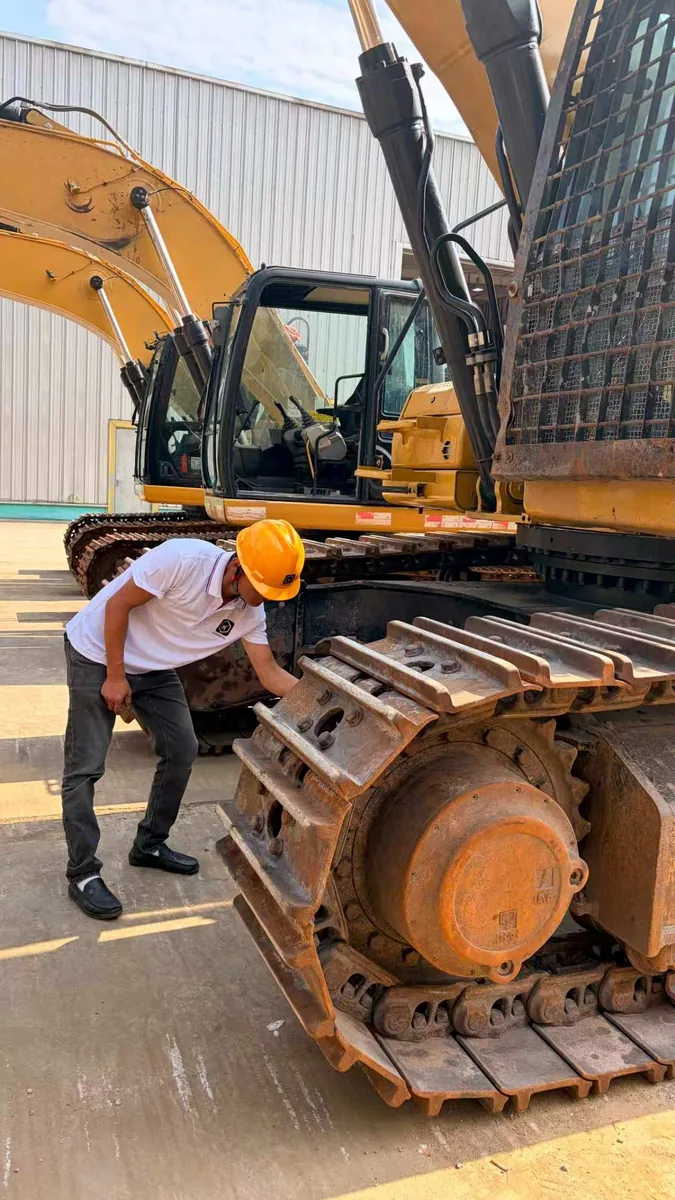
Drafted with AI assistance. The maker notices, US regulations and Canadian law were checked against the linked pages on 30 September 2026; the Reddit quotations are from the linked comments. Prepared by HCQ Machinery’s export team. The photographs are of machines in our yard.