How Many Hours Is a Lot for an Excavator or Mini Excavator?
Release time: 2026-10-02
For a Cat engine, “a lot” starts near 8,000 hours: Caterpillar’s operation manuals for the 320 and for its 1.5 to 2 ton mini excavators both give 8,000 service hours as the expected interval to engine overhaul. We found no equivalent published figure from Komatsu, Deere, Cummins or Isuzu, so for other makes judge the hours against the machine’s age. The 8,000 figure is a planning point for engine work. Undercarriage, final drives and swing parts wear on their own schedules, so a used excavator is judged on those parts and on whether its hours fit its age.
“A low hour machine can be worn out,” one commenter told a buyer on r/heavyequipment (24 April 2025), adding that “you can get a high hour machine that’s solid.” The rest of this guide explains why both halves of that sentence hold, and what to check instead of the number.
What the hour meter counts
The hour meter records engine running time, not work done. Komatsu’s operation manual for the PC88MR-10 (form PEN01034-03) says the service meter advances “even when the machine is not moving” and adds “0.1 every 6 operation minutes, regardless of the engine speed.” An hour at idle while a truck is loaded counts the same as an hour in rock. Caterpillar’s mini excavator manual (M0088895-13) describes its meter the same way: it “shows the total operating hours of the engine.”
Caterpillar also separates meter hours from clock hours when it costs machines. Its Performance Handbook, edition 50, states that in its owning and operating cost section “the word ‘hour’ … means clock or operating hours, not Service Meter Units.” Even Caterpillar does not treat a meter hour as a unit of work. The meter tells you how long the engine ran; the wear on the machine tells you how hard.
The 8,000-hour figure, and what it is not
Two Caterpillar manuals give the same number:
- Cat 320 and 323 excavators, operation and maintenance manual M0068104-12 (November 2020): “The expected life interval of this machine is 8,000 service hours. The expected life interval corresponds to the service hours to engine overhaul.”
- Cat 301.5 to 302 CR mini excavators, manual M0088895-13 (January 2022): the same 8,000 service hours, “to engine overhaul or replacement.”
The 320 manual adds that the interval “may vary based on overall machine duty cycle,” and at that point it says to “remove the machine from operation and consult your Cat dealer” to inspect, repair, rebuild or dispose of it, then set a new interval. So 8,000 hours is where Caterpillar expects the engine to need planned work, on Cat models only. Do not apply it to other makers’ engines as if it were theirs.
A second 8,000 appears in US emission law and is often confused with engine life. 40 CFR 1039.101, Table 4, sets the emissions “useful life” for nonroad diesel engines of 37 kW and above certified under Part 1039 at “8,000 hours or ten years, whichever comes first.” For engines under 19 kW, common on small minis, the same table gives 3,000 hours or five years. That is the period over which the engine must stay within its emission limits. It says nothing about when the engine wears out.
Check the hours against the machine’s age
Hours only mean something next to the build year. Komatsu publishes monthly average operating hours for the construction machines that report through its KOMTRAX telematics system (mini and mining machines excluded). For September 2025 to August 2026 the monthly averages ranged as follows. The yearly totals are our sum of Komatsu’s twelve monthly figures, not a number Komatsu prints.
| Region (Komatsu KOMTRAX data) | Average hours per machine per month, Sep 2025 to Aug 2026 | Sum of the 12 months (our arithmetic) | What 10 years at that rate would show |
|---|---|---|---|
| Japan | 41.4 to 57.4 | about 576 | about 5,760 hours |
| North America | 57.6 to 70.8 | about 772 | about 7,720 hours |
| Europe | 54.2 to 78.6 | about 824 | about 8,240 hours |
| Indonesia | 176.7 to 212.7 | about 2,362 | about 23,620 hours |
Source: Komatsu Ltd., monthly KOMTRAX data, latest month August 2026. Komatsu also notes that its Japan data population changed from April 2026, when 3G mobile service ended, and the figures include machines that logged zero hours in a month and cover all its construction equipment, not excavators alone.
Chart: sum of Komatsu’s published monthly averages for each region, September 2025 to August 2026. The arithmetic is ours.
At the same pace, a machine’s expected hours by age look like this (our arithmetic at the September 2025 to August 2026 rate; real machines vary widely around these figures):
| Age of machine | Japan pace | North America pace | Europe pace |
|---|---|---|---|
| 5 years | about 2,880 hours | about 3,860 hours | about 4,120 hours |
| 10 years | about 5,760 hours | about 7,720 hours | about 8,240 hours |
| 15 years | about 8,640 hours | about 11,580 hours | about 12,360 hours |
| 20 years | about 11,520 hours | about 15,440 hours | about 16,480 hours |
Two things follow for anyone buying an excavator that worked in Japan, as many of the machines in our yard did (the decals on the machine pictured below are Japanese).
First, a Japanese machine with modest hours for its age is normal. At the Japanese average, a ten-year-old machine would show a little under 6,000 hours, which is below the 8,000-hour point for a Cat 320 engine.
Second, hours far below even that pace need an explanation. A machine built in 2012 and showing 3,000 hours in 2026 has averaged about 214 hours a year, well under half the Japanese figure. That can be true for a standby or yard machine, but ask for the service record, and read our guide to hour meter fraud warning signs before paying a premium for low hours. The same logic runs the other way: a machine that worked in a high-use market can carry far more hours at the same age.
The US Environmental Protection Agency uses a different default, 1,092 hours a year for a diesel excavator, in its emissions model (EPA-420-R-10-016, 2010). The report says its activity data comes from a 1998 database, so treat it as an old model input rather than a current fleet average.
What public listings show
To see how real machines compare, we took 17 public listings and auction lots for 20 ton class excavators on MachineryTrader and Ritchie Bros on 30 September 2026 and divided each machine’s meter hours by its age (2026 minus the model year). This is a small sample of what sellers chose to list, mostly in North America, not a market statistic.
| Machine | Year | Meter hours | Hours per year | Where listed |
|---|---|---|---|---|
| Cat 320CL | 2003 | 13,822 | 601 | Cat dealer, North Carolina |
| Komatsu PC200LC-7 | 2005 | 7,939 | 378 | Ritchie Bros, Alberta |
| Cat 320CL | 2005 | 7,583 | 361 | Florida |
| Komatsu PC200LC-8 | 2006 | 12,053 | 603 | Ritchie Bros, Alberta |
| Cat 320D | 2007 | 19,364 | 1,019 | Mexico |
| Cat 320D | 2011 | 5,583 | 372 | British Columbia |
| Cat 320EL | 2012 | 10,166 | 726 | South Carolina |
| Cat 320D | 2013 | 115 | 9 | Changsha, China |
| Komatsu PC210LC | 2013 | 9,130 | 702 | Auction, Mississippi |
| Volvo EC220DL | 2013 | 11,510 | 885 | Tennessee |
| Cat 320ELRR | 2015 | 6,740 | 613 | Cat dealer, Virginia |
| Volvo EC220EL | 2016 | 10,674 | 1,067 | Pennsylvania |
| Cat 320FL | 2017 | 9,560 | 1,062 | Kentucky |
| Hitachi ZX200-6 | 2018 | 3,211 | 401 | Ritchie Bros, Tennessee |
| Komatsu PC210LC-11 | 2019 | 3,348 | 478 | Auction, British Columbia |
| Cat 320 | 2020 | 7,452 | 1,242 | Pennsylvania |
| Cat 320 | 2022 | 5,076 | 1,269 | Idaho |
The for-sale rows were live on 30 September 2026; the auction rows had already sold, in 2025 or 2026 where the date is shown, so their true age at sale was up to about a year and a half less and their hours per year are, if anything, understated. The median of the 17 is 613 hours a year, between Komatsu’s Japan and North America averages above. Three things stand out:
- Four of the six machines from 2016 onward ran over 1,000 hours a year (1,062 to 1,269), close to or above EPA’s 1,092-hour default, while all four from 2006 or earlier ran 361 to 603. There are exceptions both ways: the 2018 Hitachi and 2019 Komatsu auction lots ran 401 and 478, and a 2007 Cat 320D in Mexico ran 1,019. A sample this size shows how widely machines vary, not a trend.
- One machine showed three different hour figures. The Cat dealer’s report on the 2003 320CL reads: “Hour meter showing 13,792 hrs. ET shows 13,822 hrs. Customer states hours are at 15,276 hrs.with meter replacement.” A replaced meter is not fraud, but it is why the service record matters more than the display. The same listing’s description calls it a “2001 USED CAT 320C L”, so even the year needs checking; the table uses the 2003 year field and the 13,822 service tool reading.
- One 2013 Cat 320D was listed at 115 hours, 9 hours a year for 13 years. The listing states it is “NOT for use in US and/or CANADA”, gives “Hours Since Overhaul: 10” and a serial number of “01”, and shows no service record. A figure that low calls for proof of where the machine has been, not a premium.
Neither the sites nor the auction houses vouch for the numbers. Every Ritchie Bros lot we read carried the line “No guarantees made as to actual hours/miles/kilometers”, and MachineryTrader’s “Accurate / Verified” hours field is part of the seller’s listing; the site does not say it checks it.
Mini excavators: the same meter, a different owner
Caterpillar’s 8,000-hour expected life interval applies to its 1.5 to 2 ton minis as well as to the 20 ton 320, so there is no official reason to treat mini excavator hours more harshly. What differs is who owns them. On the same Reddit thread, one reply split the decision by whether the buyer is “mechanically inclined”: “If yes get a mini with over 2000hrs. If no stay under 500-800hrs” (r/heavyequipment, 23 April 2025). That is one commenter’s rule, not a manufacturer figure, but it names the real question: a high-hour mini is a good buy for someone who will change the pins, bushings and hoses themselves, and a poor one for someone who will pay a dealer to do it.
On a mini, the parts that decide the price are usually the rubber tracks, the pins and bushings on the boom, arm and blade, and the swing and travel motors. Caterpillar’s mini excavator manual gives a rubber track replacement point when the grousers are “worn down to approximately 5 mm.” Grouser height can be measured on a video call with a ruler. Public listings show how widely mini excavator hours vary. Two 2007 Takeuchi TB135s (about 3.5 t) were listed at 6,800 and 3,869 hours on 30 September 2026, about 358 and 204 a year. A 2019 Cat 308 CR at 2,539 hours carried the dealer note “Engine was replaced at 2524hrs”, so its machine hours and engine hours tell different stories; ask which one you are being quoted.
Ex-rental machines: fleet age, fleet numbers and service records
Buyers disagree about rental machines. One view, from a skid steer thread: “General consensus is never buy a rental machine” (r/Skidsteer, 14 July 2025). The other: “Id rather buy a rental machine than a contractors machine most of the time” (r/miniexcavator, 8 August 2026).
The rental companies’ own filings show why rental machines reach the used market young. In their latest annual reports to the US Securities and Exchange Commission, the average fleet age reported was (Sunbelt’s figure covers serialized equipment, weighted by original cost):
| Rental company | Average fleet age | Date | Source |
|---|---|---|---|
| United Rentals | 49.5 months | end of 2025 | Form 10-K, fiscal 2025 |
| Herc Rentals | 45 months | 31 December 2025 | Form 10-K, fiscal 2025 |
| Sunbelt Rentals | about 53 months | 30 April 2026 | Form 10-K, fiscal year to April 2026 |
Sunbelt’s filing adds that it sells equipment “on average, after seven to eight years of ownership.” None of the three reports hours at sale, and the fleet ages cover every kind of machine they rent, not excavators alone.
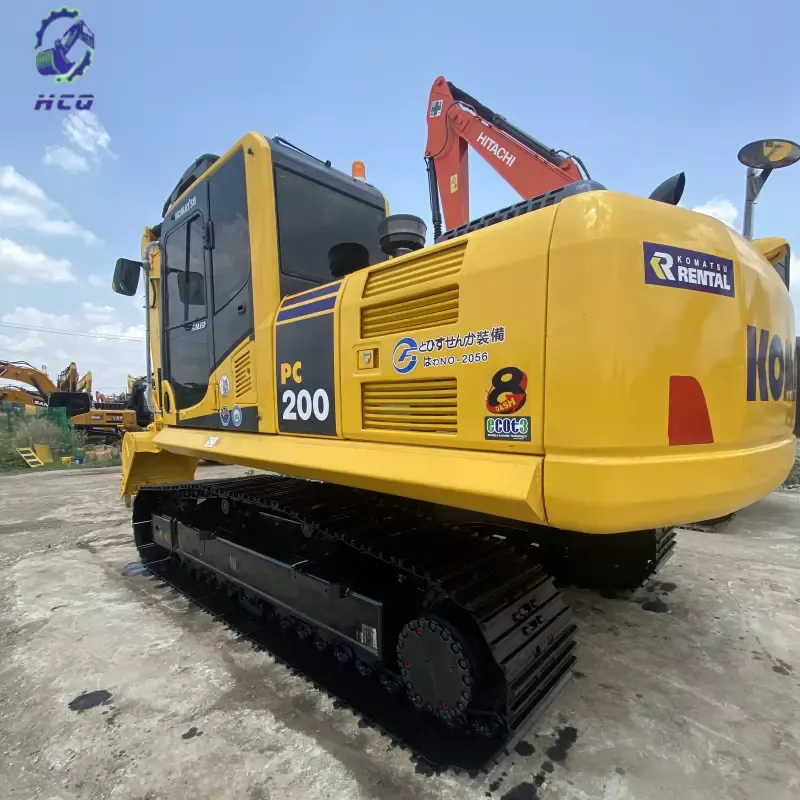
A Komatsu PC200-8 in our yard, photographed for our library in June 2026. The decal on the side panel is a Japanese equipment company’s name with the fleet number “NO-2056”, and the machine also carries a rental company decal. A fleet number means the machine was managed in a fleet, so ask whether its service history came with it.
Rental machines are usually maintained to a fleet schedule, and the record is what makes that worth paying for. When a used excavator carries a fleet number or a rental company’s name, ask the seller for the service record under that number. If none can be produced, price the machine as if there were none.
What outweighs the hour meter
Every part below wears at a rate set by the job, the ground and the operator, which is why two machines with the same hours can be priced thousands apart. Check these before you agree a price.
| Part | Why the hours do not tell you its condition | How to check it |
|---|---|---|
| Undercarriage: track links, pins and bushings, rollers, idlers, sprockets | Travel distance and rock wear it far faster than digging in soil (Caterpillar’s Performance Handbook calls the amount of travel “the critical part” of its undercarriage “Z” factor for large excavators) | Track sag measurement and sprocket tooth shape: excavator undercarriage wear guide |
| Final drives and travel motors | Oil level and seal condition matter more than age | Level plug check, drained oil, 20 m travel test: final drive and travel motor checks |
| Swing motor, swing gear and swing bearing | Swing wear follows the number and load of swing cycles, which the meter does not record | Timed swing, drift test, bearing play: swing motor and swing bearing checks |
| Engine emission hardware | Tier 4 Final and Stage V machines carry filters and fluids with their own service intervals | Engine label and service record: Tier 3 vs Tier 4 used excavators |
| Hydraulic pump and cylinders | Internal leakage does not show on the meter | Cycle times and drift: hydraulic system checks |
Caterpillar’s handbook lists the factors with the “greatest influence on resale or trade-in value” as the machine’s age, “the number of hours on the machine,” the type of jobs and operating conditions, and “the physical condition of the machine.” Hours are one of four factors.
What to ask a seller for
Ask any seller, us included, for these before discussing price:
- A photo of the hour meter or monitor with the engine running, and a photo of the serial plate, taken on the same day.
- The build year from the serial plate, so you can compare hours with age using the tables above (full-size machines only; Komatsu’s data excludes minis).
- A cold start video from the moment the key turns.
- The service record, or the rental fleet number if the machine carries one.
- Close-ups of the sprockets, the track links and the final drive covers.
If the hours and the wear disagree, trust the wear. A 7,000-hour machine whose parts match its hours is usually easier to price than a 3,000-hour machine whose parts do not.
For machines we list now, see a Komatsu PC200, a Cat 320D2L and a Komatsu PC56 mini excavator, or the full list of used excavators.
Frequently asked questions
How many hours does an excavator last? Caterpillar is the only maker we found that publishes a figure: its 320 manual gives an expected life interval of 8,000 service hours, tied to engine overhaul, after which the dealer decides whether to repair, rebuild or dispose of the machine.
Is 6,000 hours a lot for an excavator? For a Cat 320 it is three quarters of the way to Caterpillar’s 8,000-hour engine overhaul interval. Whether it is “a lot” depends on age and condition: for a ten-year-old machine from Japan, 6,000 hours is close to the average pace in Komatsu’s data.
What is considered high hours on a mini excavator? Caterpillar gives its 1.5 to 2 ton minis the same 8,000-hour expected life interval as the 320. Buyers set lower limits because they price in their own repair costs; a mini’s tracks, pins and motors decide its value more than its meter.
Does idle time count on an excavator hour meter? Yes. Komatsu’s manual says the meter advances whenever the engine is running, even when the machine is not moving, regardless of engine speed.
This article was drafted with AI assistance. The manual excerpts, SEC filings and Komatsu data were checked against the linked documents on 30 September 2026, and HCQ Machinery’s export team reviewed the article before publication. The photograph shows a machine in our yard; the chart is drawn from Komatsu’s published figures.