Tier 3 vs Tier 4 Used Excavators and Skid Steers: DPF, DEF and Regeneration
Release time: 2026-10-08
A Tier 3 excavator engine meets US emission limits that applied from 2006 to 2008, generally without an exhaust filter or urea. A Tier 4 Final engine, required for all US nonroad diesel engines of 56 to 560 kW from model year 2014 (equipment makers had limited allowances under 40 CFR 1039.625 to keep fitting earlier engines), has a particulate limit 90% lower than Tier 3 and a combined NOx and hydrocarbon limit about 85% lower, and engines meet it with a diesel particulate filter (DPF), diesel exhaust fluid (DEF) or both. For a used buyer, that means a Tier 4 Final machine brings a filter that regenerates, a second fluid to buy and store, and more sensors, in return for being accepted where newer rules apply.
“No DPF, no AdBlue, no regen.” That was how someone who works around rental yards summed up the upside of a pre-Stage IIIB machine (an EU emission stage) for a buyer looking at roughly 5 tonne excavators in Europe, on r/Heavy_Equipment (10 August 2026). This guide sets out what that trade costs and saves. It does not cover removing or disabling emission equipment, which is illegal in the United States and many other places.
The limits behind the names
The tiers are US Environmental Protection Agency standards for nonroad diesel engines; the European Union’s equivalent stages run on a similar timeline. Limits are in grams per kilowatt-hour.
| Standard | Power band | From | NOx (or NOx + NMHC) | Particulate matter | Particle number | Source |
|---|---|---|---|---|---|---|
| EPA Tier 3 | 130 to 560 kW | 2006 | 4.0 (NOx + NMHC) | 0.20 | none | 40 CFR 1039, Appendix I |
| EPA Tier 3 | 75 to 130 kW | 2007 | 4.0 (NOx + NMHC) | 0.30 | none | same |
| EPA Interim Tier 4, phase-out engines (sold as “Tier 4 Interim”) | 130 to 560 kW | 2011 to 2013 | 4.0 (NOx + NMHC) | 0.02 | none | 40 CFR 1039.102, Table 6 |
| EPA Tier 4 Final | 130 to 560 kW | at least half of each maker’s engines from 2011; all engines from 2014 | 0.40 NOx, plus 0.19 NMHC | 0.02 | none | 40 CFR 1039.101 and 1039.102 |
| EPA Interim Tier 4, phase-out engines | 56 to 130 kW | 2012 to 2013 | 4.7 (56 to 75 kW) or 4.0 (75 to 130 kW) (NOx + NMHC) | 0.02 | none | same, Tables 4 and 5 |
| EPA Tier 4 Final | 56 to 130 kW | at least half of each maker’s engines from 2012; all engines from 2014 | 0.40 NOx, plus 0.19 NMHC | 0.02 | none | same |
| EPA Tier 3 | 37 to 75 kW | 2008 | 4.7 (NOx + NMHC) | 0.40 | none | 40 CFR 1039, Appendix I |
| EPA Tier 4 Final | 19 to 56 kW | 2013 | 4.7 (NOx + NMHC) | 0.03 | none | 40 CFR 1039.101 |
| EU Stage V | 130 to 560 kW | placed on the market from 1 January 2019 | 0.40 NOx, 0.19 HC | 0.015 | 1 x 10^12 per kWh | Regulation (EU) 2016/1628, Annexes II and III |
| EU Stage V | 56 to 130 kW | placed on the market from 1 January 2020 | 0.40 NOx, 0.19 HC | 0.015 | 1 x 10^12 per kWh | same |
Two points from the table matter when buying. First, a machine’s year alone does not tell you its tier, because Tier 4 was phased in over two or three years. During those years half of each maker’s engines could meet the older NOx limit while already meeting the new 0.02 particulate limit; these are the engines sold as Tier 4 Interim. Second, the percentages in the answer above are our arithmetic from the table: particulate falls from 0.20 to 0.02 in the larger band (90%), and NOx plus hydrocarbons from 4.0 to 0.59 (about 85%). EPA notes that Tier 1 to 3 limits were tested on a steady-state cycle only, so the numbers are not a like-for-like lab comparison.
Not every Tier 4 Final engine has a particulate filter. DieselNet’s summary of the US standards notes that “some Tier 4 engines also utilize a DPF, while others meet the standards without particulate filters” (DieselNet). Stage V adds a particle number limit, which Tier 4 Final does not have.
What the exhaust hardware does
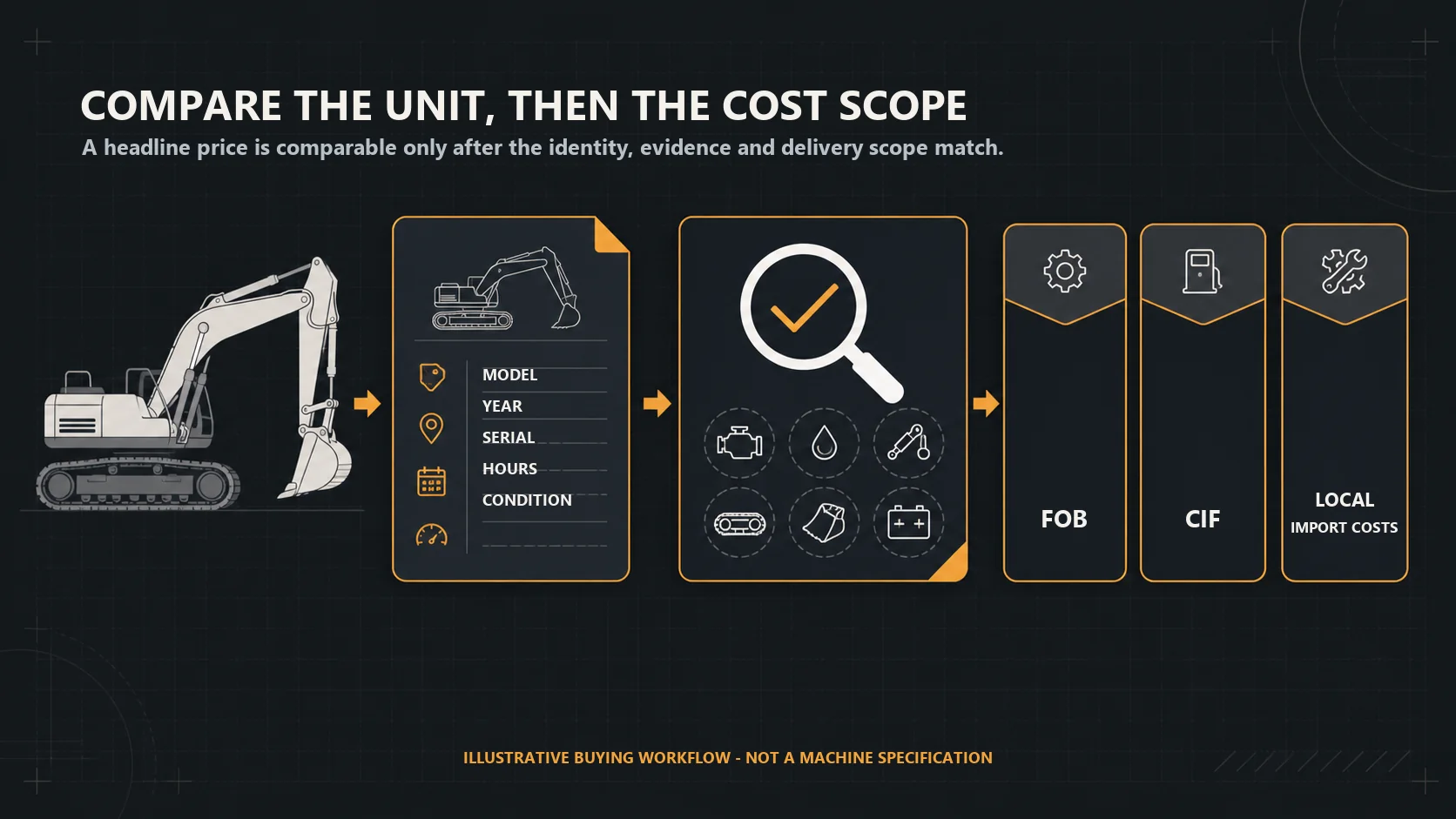
Illustration of a typical layout. Makers combine or omit parts; not every Tier 4 Final engine has every box.
The DPF traps soot. Caterpillar describes it simply: “A diesel particulate filter traps particles that enter the exhaust stream” (Cat). The soot has to be burned off, which is regeneration. Komatsu’s Tier 4 overview describes three levels (Komatsu, Tier 4 Engine Technology Overview):
| Regeneration | What happens (Komatsu) | What the operator does |
|---|---|---|
| Passive | Exhaust is hot enough, above about 250°C, that soot burns off faster than it builds up | Nothing |
| Active | The system injects fuel into the exhaust to raise it to about 500°C | Usually nothing; the machine keeps working |
| Manual stationary | The machine is parked and the exhaust is raised to about 550°C | Starts it when prompted; Komatsu says the machine “will be derated by 25% or more” if it is ignored |
Over time the filter also collects ash that does not burn. Kubota’s engine division warns that “ash buildup in the filter can restrict exhaust gas flow and increase back pressure” (Kubota Engine America), so the filter is eventually removed and cleaned or exchanged.
DEF and SCR reduce NOx. DEF, sold as AdBlue in Europe, is a urea solution injected into the exhaust, where, in Komatsu’s words, the heat “decomposes the urea into ammonia” and the SCR catalyst “reduces the NOx into water vapor and nitrogen gas.”
What Tier 4 Final adds to running costs
These are the service items that a Tier 3 machine does not have. The intervals are the makers’ published figures for their own engines; check the manual for the model you are buying.
| Item | Published figure | Scope |
|---|---|---|
| DPF exchange or clean, DEF tank flush | 4,500 hours | Komatsu Tier 4 machines with engines over 128 kW |
| DEF and crankcase ventilation filters | 2,000 hours | Komatsu Tier 4 machines |
| DEF tank breather element | 1,000 hours | Komatsu Tier 4 machines |
| DPF service | “up to 15,000 hours” | John Deere industrial engines (Deere brochure DSWT88) |
| DEF refill ratio | “1 tank of AdBlue/DEF will last approximately 2 tanks of fuel” | Komatsu; Caterpillar sizes its DEF tank for a “1:1 fill rate” with fuel (Cat) |
DEF has handling rules of its own. Caterpillar requires DEF that meets ISO 22241-1, the quality standard for the 32.5% urea solution sold as AUS 32. Caterpillar gives the ideal storage temperature as -9°C to 25°C (15°F to 77°F) and says it “will start to freeze at 12 degrees Fahrenheit (-11°C)”, adding that freezing does not change its effectiveness. Volvo Construction Equipment says it “can last up to one year” (Volvo CE). On a remote site, that means a second fluid to ship, store out of the sun and use within a year.
In the United States, running a urea-SCR engine without proper DEF is also a legal problem. 40 CFR 1068.101(b)(1) counts “operating an engine without a supply of appropriate quality urea” as tampering. EPA has issued guidance in August 2025 and March 2026 asking makers to reduce DEF-related derates on machines already in use; that is guidance to manufacturers, not a change in the tampering rule (EPA DEF fact sheet, March 2026).
How to tell which tier a used machine has
The engine’s emission label is the only reliable answer. Ask for a clear photo of it before anything else. What the label says depends on the rule the engine was certified under. A Tier 4 engine certified under 40 CFR 1039.135 carries a permanent label with:
- the heading “EMISSION CONTROL INFORMATION” and the engine maker’s name;
- EPA’s designation for the engine family, and the power category that sets its limits;
- usually the displacement, the date of manufacture and the emission-control system (the rule lets each of these go elsewhere in some cases);
- for diesel, “ULTRA LOW SULFUR FUEL ONLY”;
- the statement “THIS ENGINE COMPLIES WITH U.S. EPA REGULATIONS FOR [MODEL YEAR] NONROAD DIESEL ENGINES.”
Most Tier 3 engines were certified under the older 40 CFR Part 89. Its label rule, §89.110 (2012 edition), required the heading “Important Engine Information” and the statement “This engine conforms to [model year] U.S. EPA regulations large nonroad compression-ignition engines”. A genuine Tier 3 label will not match the Tier 4 wording above.
Neither label has to print the word “Tier”. To find the tier, look up the engine family in EPA’s public certification data. For example, EPA’s spreadsheet for 2011 onward lists the 2021 Komatsu SAA6D107E-3-A engine, family MKLXL06.7AAP, in the 75 to 130 kW category as “Tier 4 (Final or Phase In)”. Engines certified up to model year 2011 are in EPA’s archive file, which has no tier column; for those, read the tier from the model year and power category on the label. Both rules require the label to be in English, readable for the life of the engine and attached so that it cannot be removed without being destroyed (40 CFR 1068.45 for Tier 4; §89.110(a) for Tier 3); a missing or unreadable label is a question to settle before you pay. Other clues help:
- Decals. Komatsu marked its Tier 3 generation engines “ecot3”. Its 2006 PC200-8 brochure describes the engine as “Tier 3 EPA, EU Stage 3A ready ‘ecot3′” (Komatsu brochure AESS688-01). “Ready” is the brochure’s wording, not a certificate.
- A second filler cap and tank, usually blue, is for DEF. Its presence means SCR.
- Regeneration switches or a DPF indicator on the monitor mean a particulate filter.
- The model suffix can change with the tier, but not consistently across brands, so it only confirms what the label says.
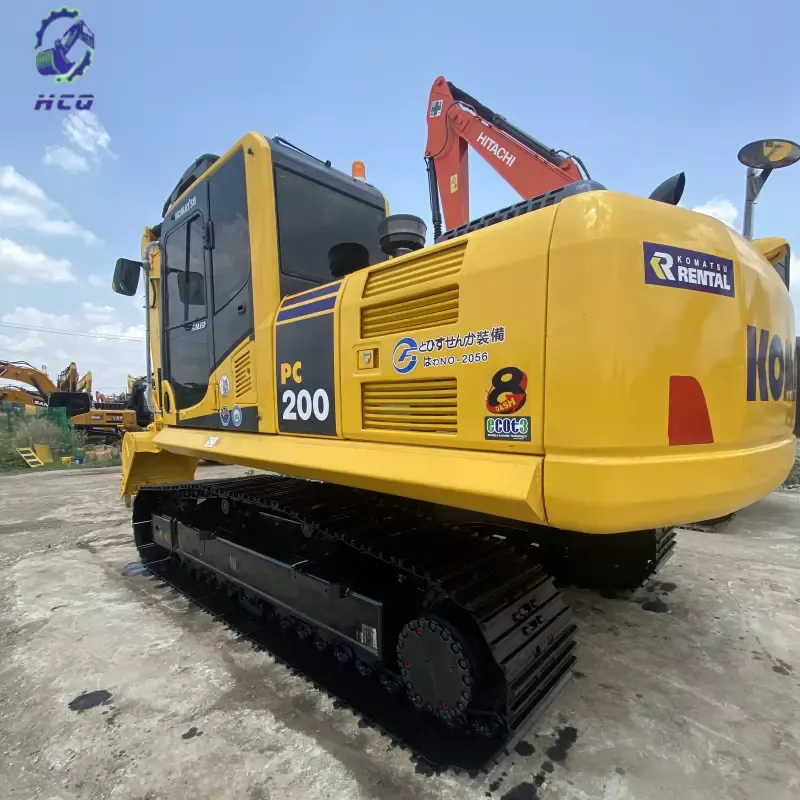
The “ecot3” decal on a Komatsu PC200-8 in our yard, June 2026: Komatsu’s marking for its Tier 3 generation engine. This machine worked for a Japanese fleet, so the decal alone does not show EPA certification; the engine label does, and it is the document to photograph and keep.
Machines built for the Japanese market from 2006 onward carry Japan’s Off-Road Act label, and may carry no EPA label. What those labels mean, and what a Japan-market machine means for import and parts, is covered in our guide to grey market excavators.
Skid steers: the same choice on a smaller engine
The same trade applies to skid steers, with two differences. Smaller skid steers have engines under 56 kW (about 75 hp). In the 19 to 56 kW band Tier 4 Final cut particulates to 0.03 g/kWh but kept the NOx plus hydrocarbon limit at 4.7, the Tier 3 figure for 37 to 75 kW, so these machines usually need a particulate solution but not always SCR and DEF. Check the engine label rather than assuming either. And skid steer owners are often more direct about avoiding them. One owner of Cat skid steers wrote that “at around 5k hours the DPF is due for replacement or cleaning” (r/Skidsteer, 14 July 2025); another said, “I usually try to stay away from the newer machines due to the emission controls” (r/Skidsteer, 2 November 2024). Those are owner reports, not maker figures; the engine maker’s service schedule decides the real interval. For the rest of a skid steer’s checks, see our used skid steer loader buying guide.
Which one to buy
| If your machine will… | Tier 3 | Tier 4 Final or Stage V |
|---|---|---|
| Work in a country or on a contract that requires Tier 4 Final or Stage V | Not accepted | Required |
| Work far from dealers, with uncertain diesel and no DEF supply | Simpler: no DEF, no filter regeneration | Needs a DEF supply, clean fuel and a plan for filter service |
| Idle for long periods or work light loads | No regeneration concerns | Light, cool running gives less passive regeneration, so expect more active or parked regenerations |
| Be resold into a regulated market | Narrower resale market | Wider resale market |
Where a machine may legally be imported and registered depends on the destination’s rules, and those differ country by country; our guide to used construction equipment import requirements by destination covers them with the official sources, including California’s fleet rule on adding older-tier machines. Emission tier is one of the parts of a used machine that the hour meter does not describe; the others are in how many hours is a lot for an excavator.
Whatever the tier, the engine label is the first photo to ask us for on any machine on our used excavators page.
Frequently asked questions
What is the difference between Tier 3 and Tier 4 Final? In the 130 to 560 kW band, Tier 4 Final cuts particulate matter from 0.20 to 0.02 g/kWh and NOx plus hydrocarbons from a combined 4.0 to 0.59 g/kWh (0.40 NOx plus 0.19 NMHC), which engines meet with a DPF, SCR with DEF, or both. Tier 3 engines generally meet their limits without exhaust aftertreatment.
What is DPF regeneration? Burning the soot collected in the diesel particulate filter. It happens on its own when the exhaust is hot enough, is forced by the engine when needed, or is run with the machine parked when the system asks for it.
Do Tier 3 excavators use DEF? No. DEF is used by engines with SCR, which came in with Tier 4.
Is it legal to remove a DPF or run without DEF? Not in the United States: removing or disabling emission equipment is prohibited, and running a urea-SCR engine without appropriate DEF counts as tampering under 40 CFR 1068.101. Other countries have their own rules.
Drafted with AI assistance. The limits were checked against the eCFR and the EU regulation text, and the maker figures against the Komatsu, Caterpillar, John Deere, Kubota and Volvo documents linked above, on 30 September 2026. Prepared by HCQ Machinery’s export team. The diagram is an illustration; the photograph is of a machine in our yard.